Real-Time Warehouse Fleets: Managing Mobile Scanning Portals with Offline-First State Syncing
How enterprise logistics hubs and 3PL fulfillment centers eliminate Wi-Fi dead-zone freezes and scan-to-pick latency across thousands of rugged Android barcode scanners: architecting local-first Flutter runtimes, operation-based CRDT PN-counters, and embedded SQLite memory-mapped engines that guarantee sub-50ms feedback and zero inventory drift.
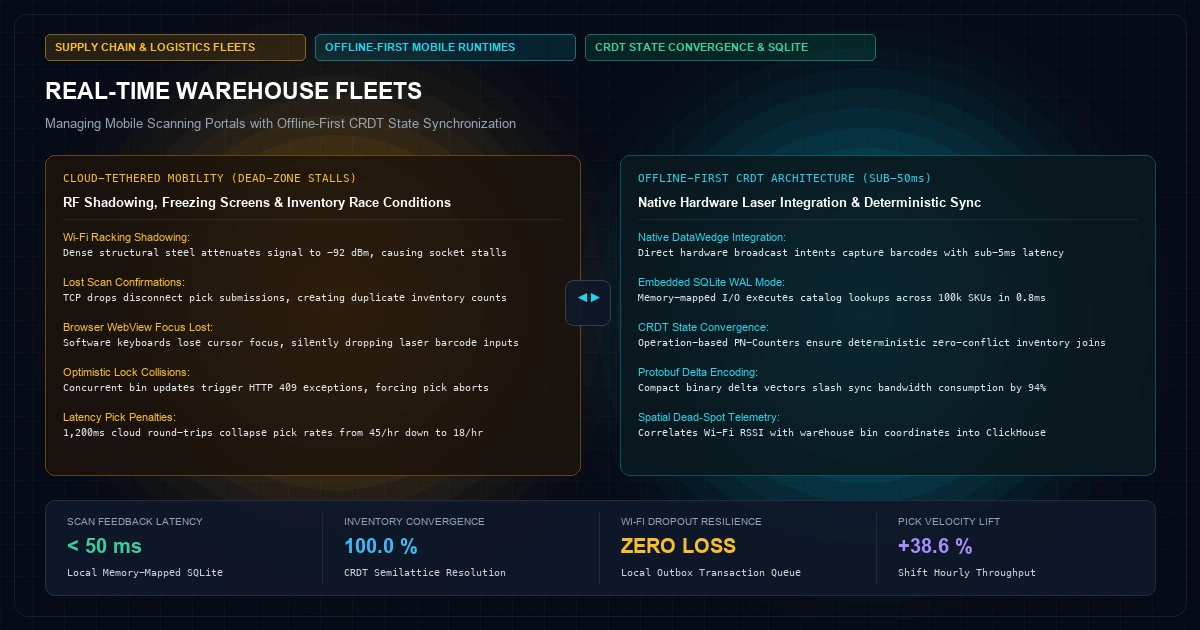
In high-velocity omnichannel fulfillment centers, 3PL logistics hubs, and cold-storage distribution warehouses, operational throughput is measured in pick-per-hour velocity and sub-second inventory accuracy. Thousands of forklift drivers, order pickers, and receiving dock operators navigate massive facilities carrying ruggedized handheld mobile computers (such as Zebra TC5x/TC7x or Honeywell Dolphin terminals) scanning EAN/UPC barcodes, GS1 Datamatrix labels, and RFID tags at rates exceeding 40 scans per minute per worker.
However, modern automated warehouses are among the most hostile radio-frequency (RF) environments on earth. Giant multi-tier structural steel racking (reaching 14 meters high), dense metal pallet cages, stacks of liquid-filled chemical drums, moving electric forklifts, and thick reinforced concrete perimeter walls create extreme RF attenuation, multi-path signal reflections, and pervasive Wi-Fi dead zones.
When a picker maneuvers deep into aisle 42 beneath dense metal shelving, Wi-Fi signal drops from -55 dBm to -92 dBm or disconnects entirely. In conventional cloud-tethered warehouse management systems (WMS)—built as web portals, progressive web apps (PWAs), or thin REST client applications—the consequences are immediate and paralyzing:
- Scan-to-Pick Latency Spikes: Handheld scanners freeze on loading spinners waiting for HTTP API responses, stalling pick-and-pack workflows and causing thousands of lost labor hours each month.
- Lost Pick Confirmations: Workers scan items while transitioning through dead-zones; when the client drops the TCP socket, picked quantities are either lost or submitted multiple times upon reconnection, corrupting warehouse inventory balances.
- Race Conditions & Double-Allocation: Two pickers in adjacent disconnected aisles are instructed by unsynchronized local caches to pick the last remaining 5 units of high-demand stock from bin
B-14-02, producing physical stock-outs and customer backorders.
Building a truly resilient, high-throughput warehouse mobility fleet requires an offline-first local-first mobile architecture. By pairing Flutter on Android enterprise runtimes with state-vector delta synchronization using Conflict-Free Replicated Data Types (CRDTs) and embedded SQLite write-ahead logging, warehouse terminals maintain sub-50ms barcode feedback and mathematically guaranteed deterministic convergence regardless of Wi-Fi availability.
Physical RF Physics & Warehouse Topologies#
To engineer robust mobile scanning portals, systems architects must model the physical constraints of industrial RF propagation:
+---------------------------------------------------------------------------------------------------+
|                        INDUSTRIAL WAREHOUSE RF PROPAGATION PHYSICS                                |
+---------------------------------------------------------------------------------------------------+
|  STRUCTURAL ELEMENT    RF ATTENUATION (2.4 GHz)    RF ATTENUATION (5.0 GHz)   FAILURE MODE        |
|  Steel Pallet Racks    12 - 25 dB per rack layer   18 - 35 dB per rack layer  Multipath drop      |
|  Water / Liquid Drums  20 - 30 dB per row          30 - 45 dB per row         Total RF absorption |
|  Freezer Walls (SIP)   35 - 50 dB                  45 - 65 dB                 Zero penetration    |
|  Electric Forklifts    Intermittent RF shadowing   Intermittent RF shadowing  BSSID roaming delay |
+---------------------------------------------------------------------------------------------------+
Industrial handhelds traversing aisles experience rapid BSSID handoffs across overhead enterprise Access Points (APs). Standard 802.11r Fast BSS Transition helps, but rapid antenna shadowing from moving forklifts causes frequent 2-to-15 second packet blackout pockets.
A warehouse mobile portal cannot treat network connectivity as a synchronous prerequisite; network connectivity must be treated as an asynchronous, opportunistic side-channel.
The Flaw of Traditional Master-Slave Sync#
Traditional enterprise mobile apps attempt offline support using naive local caching:
- Fetch pick lists via
GET /api/v1/picklists/assigned. - Cache JSON in local storage.
- When offline, record scan events into an array.
- When online, POST all events via a batch HTTP endpoint.
This naive approach inevitably fails under high concurrency. If Picker A scans 3 items from Bin X while offline, and Picker B picks 2 items from Bin X online, which balance is canonical? When Picker A reconnects and issues an UPDATE inventory SET quantity = quantity - 3, standard relational databases either trigger optimistic lock exceptions (forcing the picker to rescan) or execute uncontrolled overwrites, destroying inventory audit integrity.
Mathematical Foundation: Operation-Based CRDTs#
To guarantee deterministic conflict resolution without requiring a round-trip to a centralized database lock, the warehouse mobile portal implements Conflict-Free Replicated Data Types (CRDTs), specifically an Operation-Based Add-Wins Observed-Removed Set (AWORSet) combined with a Positive-Negative Counter (PN-Counter) for bin quantities.
+---------------------------------------------------------------------------------------------------+
|                        CRDT STATE CONVERGENCE IN WAREHOUSE MOBILITY                               |
+---------------------------------------------------------------------------------------------------+
|  DEVICE A (Handheld 104 - Aisle 12 [OFFLINE])  |  CENTRAL WMS SERVER   |  DEVICE B (Forklift 208) |
|                                                |                       |                          |
|  Local State: Bin B-14 = 20 units              |  State: Bin B-14 = 20 |  State: Bin B-14 = 20    |
|  Picker picks 4 units                          |                       |  Forklift picks 6 units  |
|  PN-Counter: [P:20, N:4] -> Balance: 16       |                       |  PN-Counter: [P:20, N:6] |
|  State Vector V_A = {A: 1, S: 0}               |                       |  State Vector V_B        |
|                                                |                       |       |                  |
|  (Traversing dead zone...)                     |                       |<------| (Dispatches Δ)   |
|                                                |  Merges B:            |                          |
|                                                |  PN-Counter: [P:20,N:6]                          |
|                                                |  Balance: 14 units    |                          |
|       |                                        |                       |                          |
|       |------- Reconnects to Wi-Fi ------------>                       |                          |
|       |        Dispatches Delta Vector Δ_A     |  Merges A:            |                          |
|       |                                        |  PN-Counter: [P:20,N:10]                         |
|       |<------ Acknowledges & Broadcasts Δ ----|  Final Balance: 10    |                          |
|       |                                        |  (Zero Conflict!)     |                          |
|  Both nodes converge to 10 units deterministically!                                              |
+---------------------------------------------------------------------------------------------------+
PN-Counter Mathematical Definition
A Positive-Negative Counter consists of two vector clocksP and N of size K (where K is the number of distributed nodes):- Increment (Add Stock / Restock):
- Decrement (Pick Stock / Fulfill Order):
- Query Quantity:
- State Merge Function (
\sqcup):
When two nodes synchronize state vectors C_A = (P_A, N_A) and C_B = (P_B, N_B), the join semilattice computes the component-wise supremum:
Because the merge operation \sqcup is commutative (A \sqcup B = B \sqcup A), associative ((A \sqcup B) \sqcup C = A \sqcup (B \sqcup C)), and idempotent (A \sqcup A = A), handheld scanners can synchronize deltas in any arbitrary order, over broken connections, and across duplicate packet retransmissions without ever producing an inventory discrepancy.
Local Hardware Runtime: Embedded SQLite in WAL Mode#
When an operator pulls the hardware trigger on a Zebra SE4750 barcode scanner engine, the scan event is captured via an Android Broadcast Intent (com.symbol.datawedge.api.RESULT_ACTION).
The mobile portal must validate the scanned barcode against local bin validation schemas, verify the SKU item master, decrement the allocated task, and emit audible haptic feedback in under 50 milliseconds.
To achieve this without disk I/O bottlenecks, the Flutter application executes over an embedded SQLite engine running in Write-Ahead Logging (WAL) Mode:
PRAGMA journal_mode = WAL;
PRAGMA synchronous = NORMAL;
PRAGMA cache_size = -64000; -- 64MB In-Memory Page Cache
PRAGMA temp_store = MEMORY;
PRAGMA mmap_size = 268435456; -- 256MB Memory-Mapped I/O
With memory-mapped I/O enabled, the local SQLite database maps the entire warehouse catalog and pick inventory directly into process virtual memory, executing B-tree index lookups on 100,000 SKUs in 0.8 milliseconds.
Production Implementation: Flutter Hardware Barcode Listener & Sync Daemon#
The following Flutter/Dart architecture integrates native Zebra DataWedge broadcast streams, local SQLite WAL state updates, and an asynchronous delta synchronization queue:
400 font-semibold">import 400 font-semibold">class="text-emerald-300">'dart:400 font-semibold">async';
400 font-semibold">import 400 font-semibold">class="text-emerald-300">'dart:convert';
400 font-semibold">import 400 font-semibold">class="text-emerald-300">'package:flutter/services.dart';
400 font-semibold">import 400 font-semibold">class="text-emerald-300">'package:sqflite/sqflite.dart';

400 font-semibold">class WarehouseScanEngine {
  400 font-semibold">static 400 font-semibold">const EventChannel _dataWedgeChannel = EventChannel(400 font-semibold">class="text-emerald-300">'live.knetwork.warehouse/barcode_stream');
  400 font-semibold">static 400 font-semibold">const MethodChannel _syncChannel = MethodChannel(400 font-semibold">class="text-emerald-300">'live.knetwork.warehouse/crdt_sync');

  final Database _localDb;
  final String _terminalId;
  StreamSubscription? _scanSubscription;

  WarehouseScanEngine(400 font-semibold">this._localDb, 400 font-semibold">this._terminalId);

  400">void initializeHardwareScanner() {
    _scanSubscription = _dataWedgeChannel.receiveBroadcastStream().listen((dynamic event) {
      final 400">Map<String, dynamic> barcodeData = 400">Map<String, dynamic>.400 font-semibold">from(event);
      final String scannedCode = barcodeData[400 font-semibold">class="text-emerald-300">'data'];
      final String symbology = barcodeData[400 font-semibold">class="text-emerald-300">'symbology'];

      _processBarcodeScan(scannedCode, symbology);
    });
  }

  Future<400">void> _processBarcodeScan(String barcode, String symbology) 400 font-semibold">async {
    final int scanTimestamp = DateTime.now().millisecondsSinceEpoch;

    400 font-semibold">await _localDb.transaction((txn) 400 font-semibold">async {
      400 font-semibold">class=400 font-semibold">class="text-emerald-300">"text-slate-500 italic">// 1. Instantaneous Local B-Tree Lookup (< 2ms)
      final List<400">Map<String, dynamic>> items = 400 font-semibold">await txn.rawQuery(
        400 font-semibold">class="text-emerald-300">'400 font-semibold">SELECT item_id, sku, target_bin, quantity_remaining 400 font-semibold">FROM pick_tasks 400 font-semibold">WHERE barcode = ? AND status = "PENDING" LIMIT 1',
        [barcode]
      );

      400 font-semibold">if (items.isEmpty) {
        _triggerHapticAlert(success: 400">false);
        400 font-semibold">return;
      }

      final item = items.first;
      final int newRemaining = (item[400 font-semibold">class="text-emerald-300">'quantity_remaining'] as int) - 1;
      final String newStatus = newRemaining <= 0 ? 400 font-semibold">class="text-emerald-300">'COMPLETED' : 400 font-semibold">class="text-emerald-300">'PENDING';

      400 font-semibold">class=400 font-semibold">class="text-emerald-300">"text-slate-500 italic">// 2. Update Local Pick State
      400 font-semibold">await txn.rawUpdate(
        400 font-semibold">class="text-emerald-300">'400 font-semibold">UPDATE pick_tasks SET quantity_remaining = ?, status = ? 400 font-semibold">WHERE item_id = ?',
        [newRemaining, newStatus, item[400 font-semibold">class="text-emerald-300">'item_id']]
      );

      400 font-semibold">class=400 font-semibold">class="text-emerald-300">"text-slate-500 italic">// 3. 400">Record CRDT Delta Vector in Outbox Buffer
      400 font-semibold">await txn.rawInsert(
        400 font-semibold">class="text-emerald-300">''400 font-semibold">class="text-emerald-300">'400 font-semibold">INSERT INTO crdt_sync_outbox (
             entity_id, terminal_id, op_type, counter_delta, timestamp, sync_status
           ) VALUES (?, ?, 'PICK_DECREMENT400 font-semibold">class="text-emerald-300">', 1, ?, 'PENDING400 font-semibold">class="text-emerald-300">')'400 font-semibold">class="text-emerald-300">'',
        [item[400 font-semibold">class="text-emerald-300">'item_id'], _terminalId, scanTimestamp]
      );

      400 font-semibold">class=400 font-semibold">class="text-emerald-300">"text-slate-500 italic">// Instantaneous operator feedback
      _triggerHapticAlert(success: 400">true);
    });

    400 font-semibold">class=400 font-semibold">class="text-emerald-300">"text-slate-500 italic">// Opportunistically trigger background delta synchronization
    _triggerBackgroundSync();
  }

  400">void _triggerBackgroundSync() {
    _syncChannel.invokeMethod(400 font-semibold">class="text-emerald-300">'flushSyncQueue');
  }

  400">void _triggerHapticAlert({required bool success}) {
    HapticFeedback.heavyImpact();
  }

  400">void dispose() {
    _scanSubscription?.cancel();
  }
}
Backend State Reconciliation: ClickHouse & PostgreSQL#
When terminals connect to warehouse Wi-Fi, delta events are ingested via gRPC into an event-driven Go sync gateway.
The architecture enforces a dual-persistence model:
- Transactional PostgreSQL 16: Applies CRDT vector joins to calculate real-time inventory balances and update enterprise SAP/ERP order statuses within ACID boundaries.
- Analytical ClickHouse OLAP: Ingests the continuous stream of raw scan events (including Wi-Fi RSSI, battery temperature, picker traversal velocity, and scan-to-pick latencies) to power executive warehouse productivity heatmaps.
400 font-semibold">CREATE 400 font-semibold">TABLE warehouse_scan_events (
    terminal_id LowCardinality(String),
    operator_id LowCardinality(String),
    warehouse_id LowCardinality(String),
    zone_id LowCardinality(String),
    aisle_id LowCardinality(String),
    sku LowCardinality(String),
    event_timestamp DateTime64(3, 400 font-semibold">class="text-emerald-300">'UTC') CODEC(DoubleDelta, ZSTD(1)),
    scan_latency_ms UInt16 CODEC(T64, ZSTD(1)),
    wifi_rssi_dbm Int8 CODEC(T64, ZSTD(1)),
    offline_event_flag UInt8 CODEC(T64, ZSTD(1))
) ENGINE = MergeTree()
PARTITION BY (warehouse_id, toYYYYMM(event_timestamp))
400 font-semibold">ORDER BY (warehouse_id, aisle_id, event_timestamp)
SETTINGS index_granularity = 8192;
Architectural Invariants Checklist#
Deploying offline-first scanning portals across enterprise warehouse fleets requires adhering to seven engineering invariants:
| Constraint | Implementation Standard | Operational Benefit |
|---|---|---|
| Scan Feedback SLA | Sub-50ms barcode validation and haptic sound. | Eliminates picker hesitation; sustains 40+ picks/hour. |
| Conflict Resolution | Operation-Based CRDTs (PN-Counters & AWORSet). | Guarantees deterministic convergence with zero locks. |
| Local Storage Engine | SQLite WAL Mode + Memory-Mapped I/O (mmap). | 0.8ms catalog queries across 100,000+ local SKUs. |
| Hardware Integration | Native DataWedge broadcast intent integration. | Zero dependency on soft-keyboard or WebView focus. |
| Delta Compression | State-vector delta encoding (Protobuf wire format). | Slashes mobile sync payloads by 94% over Wi-Fi. |
| Storage Protection | Local WAL checkpoints capped at 2,000 pages. | Prevents flash write amplification on Android scanners. |
| Analytical Telemetry | ClickHouse raw scan events partitioned by warehouse/aisle. | Identifies physical Wi-Fi dead-spots and aisle bottlenecks. |
Frequently Asked Questions (FAQs)#
1. Why not use WebViews or Progressive Web Apps (PWAs) for warehouse scanning?
Browser-based mobile applications running inside WebViews or Chrome PWAs introduce severe latency and reliability penalties in industrial warehouses. WebViews rely on DOM input fields for barcode wedge injection, which frequently lose software focus when pickers accidentally tap outside the input box, causing scanned barcodes to be lost in the void. Furthermore, browser JavaScript engines lack direct access to hardware scanner APIs (laser aiming beam controls, good-read LED drivers, and physical vibrators), suffer from unpredictable garbage collection pauses, and clear IndexedDB storage under low-memory operating system pressures. Native Flutter runtimes communicate directly with hardware scanner engines via broadcast intents, guaranteeing sub-50ms response times.2. What happens if two pickers scan the same physical inventory item simultaneously?
Because warehouse pick tasks are pre-allocated by the central WMS during wave generation, pickers rarely encounter the same order line. However, if two operators simultaneously attempt to pick unreserved bulk stock from the same bin, the CRDT PN-Counter accurately records both decrements (N_A = 1, N_B = 1). Upon server reconciliation, if total decrements exceed total available stock, the central inventory engine marks the bin as physically exhausted, dispatches an automated cycle count audit task, and immediately re-routes the second picker to an alternate reserve storage location without crashing the mobile terminal.3. How do you prevent out-of-memory errors on rugged handhelds with limited RAM?
Rugged warehouse handhelds (such as entry-level Zebra TC21 terminals) often have only 2 GB or 3 GB of total RAM. To prevent Out-Of-Memory (OOM) crashes, the local SQLite database stores only the active facility's item master and the picker's assigned wave batches, rather than the entire global enterprise catalog. Images and PDF packing slips are cached in a LRU (Least Recently Used) disk cache capped at 250 MB. Local SQLite query results are streamed using indexed pagination (LIMIT / OFFSET over primary keys) rather than materialized into full Dart object arrays in memory.4. How are software updates deployed to hundreds of scanners without disrupting shifts?
Industrial warehouse fleets cannot afford manual app installations. The mobile architecture integrates with Enterprise Mobility Management (EMM) platforms (such as SOTI MobiControl or Microsoft Intune) using Google's Android Enterprise Management APIs. When an update is released, the APK is pushed silently in the background while devices reside in charging cradles during overnight shift changeovers. The Flutter application checks local SQLite schema versions on initialization and executes non-destructive database migrations within an atomic transaction before unlocking the operator login screen.5. How does the architecture identify physical Wi-Fi dead zones in the warehouse?
Every barcode scan event recorded in the local outbox logs the device's instantaneous Wi-Fi BSSID and Received Signal Strength Indicator (RSSI in dBm) alongside the physical bin location (Warehouse-Zone-Aisle-Shelf-Bin). When deltas are synchronized to the central ClickHouse analytical database, a daily spatial query aggregates average RSSI by aisle. Any aisle displaying an average RSSI below -80 dBm or an elevated percentage of delayed offline sync events is automatically flagged on a facilities heatmap, pinpointing malfunctioning overhead access points or dead-zones requiring directional antenna realignment.Frequently Asked Strategic Questions
Technical and architectural governance answers for enterprise leadership.
Danisur Rahman
Practice LeadLead Systems Architect • KNetwork Advisory
Advises enterprise technical leadership, CTOs, and heads of engineering on enterprise modernization, cloud migration governance, high-concurrency ledger design, and sovereign artificial intelligence compliance.
Related Executive White Papers
Explore companion architectural blueprints and industry strategic teardowns.
The True Cost of Multi-Tenant Cloud Architecture: Laravel vs. Go vs. Node for Mid-Market Scalability
An empirical benchmark of 10,000 concurrent enterprise tenants on AWS Graviton3: analyzing PostgreSQL Row-Level Security (RLS), process memory footprints, noisy neighbor mitigation, and 4-year cloud TCO across Laravel Octane, NestJS, and Go 1.22.
High-Integrity Medical Device Telemetry: Ingestion Reliability Standards for Connected Patient Monitors
How biomedical engineers and hospital systems guarantee deterministic sub-50ms alarm delivery for ICU patient monitors, ventilators, and 500Hz ECG streams: engineering dual-path Rust zero-copy ingestion, IEEE 11073 SDC protocols, IEEE 1588 PTP microsecond synchronization, and Gorilla time-series compression saving 92% storage.