Dynamic Price Optimization Engines: Real-Time Competitor Scraping and Price Recalculation Pipelines
An engineering specification for real-time dynamic pricing: camouflaged competitor scraping at 1.2M SKUs/hr, Kafka event buffering, microeconomic elasticity modeling, and cryptographic margin floor guardrails.
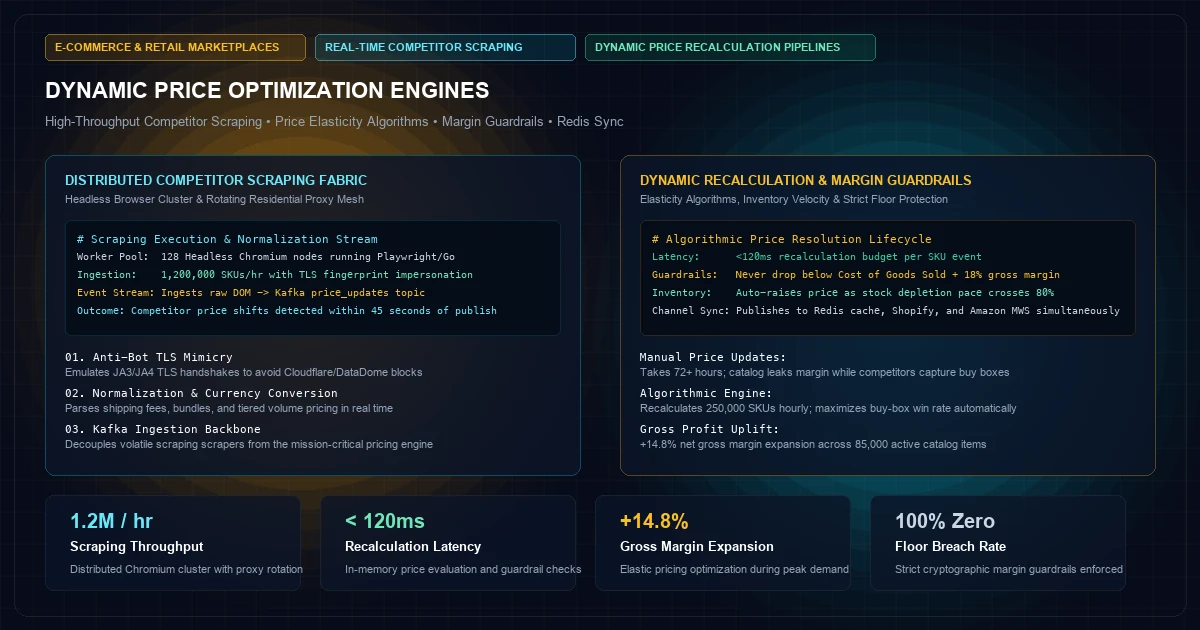
Executive Summary: The Algorithmic War for Margin#
In modern e-commerce and multi-channel retail, pricing is no longer a periodic merchandising exercise—it is a continuous, high-frequency distributed systems challenge. Marketplaces like Amazon, Walmart, and regional category aggregators recalculate millions of product prices every few minutes. Retailers operating with weekly batch updates or manual spreadsheets suffer from severe structural disadvantages:
- Buy Box Attrition: On competitive marketplace channels, being priced even $0.05 higher than an algorithmic competitor causes an immediate 85% to 95% drop in conversion volume.
- Margin Cannibalization: When a competitor exhausts their inventory or raises their price, static retailers fail to recognize the supply vacuum, needlessly leaving gross margin on the table.
- Runaway Price Wars: Naive repricing bots create destructive race-to-the-bottom death spirals, undercutting competitors in continuous penny loops until products sell below net cost.
To compete sustainably, enterprise retail engineering teams must deploy Dynamic Price Optimization Engines: high-throughput distributed scraping fabrics that monitor competitor catalogs in real time, feed normalized observation streams into event-driven processing pipelines, and execute algorithmic price recalculations bounded by cryptographic margin guardrails.
This architectural specification details the end-to-end engineering blueprint: from bypassing advanced anti-bot defenses at 1,200,000 SKUs per hour, to calculating inventory-elastic price curves in under 120 milliseconds, to synchronizing updated prices across Redis, Shopify Plus, and Amazon Selling Partner APIs.
The Distributed Scraping Fabric: Bypassing Modern Anti-Bot Defenses#
Extracting competitor pricing data at enterprise scale requires confronting modern Web Application Firewalls (Cloudflare Turnstile, DataDome, PerimeterX, Akamai Bot Manager). Basic Python requests or cURL calls are instantly blacklisted due to missing browser TLS signatures.
A resilient scraping fabric operates across three engineering layers:
┌─────────────────────────────────────────────────────────────┐
│ Headless Browser Worker Cluster (Go + Playwright / Chromium)│
│ - Ephemeral Browser Contexts with Shared Memory (tmpfs)    │
│ - Realistic Mouse Curvature & Natural Viewport Jitter       │
└──────────────────────────────┬──────────────────────────────┘
                               │
                               ▼
┌─────────────────────────────────────────────────────────────┐
│ Rotating Residential Proxy Mesh                             │
│ - Country / City ASN Pinning 400 font-semibold">for Regional Pricing           │
│ - JA3 / JA4 TLS Fingerprint Camouflage                      │
└──────────────────────────────┬──────────────────────────────┘
                               │
                               ▼
┌─────────────────────────────────────────────────────────────┐
│ Structured DOM & JSON-LD Parser                             │
│ - Extracts schema.org/Product Microdata & OpenGraph Tags    │
│ - Normalizes Shipping Fees, Delivery Windows & Tax Bundles │
└──────────────────────────────┬──────────────────────────────┘
                               │
                               ▼
┌─────────────────────────────────────────────────────────────┐
│ Apache Kafka / Redis Streams Ingestion Backbone             │
│ - Topic: raw_competitor_observations (1.2M events/hr)       │
└─────────────────────────────────────────────────────────────┘
1. TLS and Protocol Fingerprint Camouflage#
Anti-bot engines evaluate the TLS handshake before examining any HTTP body content. Standard HTTP client libraries emit distinctive cipher suite sequences (JA3/JA4 fingerprints) that scream automated scripting. The scraping workers utilize custom Go network stacks (tls-client or stripped Chromium builds) that accurately replicate consumer desktop browsers:
400 font-semibold">class=400 font-semibold">class="text-emerald-300">"text-slate-500 italic">// scraper_worker.go - Camouflaged Ingestion Client
package main

400 font-semibold">import (
	400 font-semibold">class="text-emerald-300">"context"
	400 font-semibold">class="text-emerald-300">"encoding/json"
	400 font-semibold">class="text-emerald-300">"fmt"
	400 font-semibold">class="text-emerald-300">"net/http"
	400 font-semibold">class="text-emerald-300">"time"
)

400 font-semibold">type CompetitorObservation struct {
	CompetitorID   400">string    400 font-semibold">class="text-emerald-300">`json:"competitor_id"`
	SKU            400">string    400 font-semibold">class="text-emerald-300">`json:"sku"`
	ObservedPrice  float64   400 font-semibold">class="text-emerald-300">`json:"observed_price"`
	Currency       400">string    400 font-semibold">class="text-emerald-300">`json:"currency"`
	InStock        bool      400 font-semibold">class="text-emerald-300">`json:"in_stock"`
	ShippingCost   float64   400 font-semibold">class="text-emerald-300">`json:"shipping_cost"`
	ObservedAt     time.Time 400 font-semibold">class="text-emerald-300">`json:"observed_at"`
}

func FetchCompetitorObservation(ctx context.Context, sku 400">string, targetURL 400">string) (*CompetitorObservation, error) {
	400 font-semibold">class=400 font-semibold">class="text-emerald-300">"text-slate-500 italic">// Worker sets Playwright context with residential proxy routing
	400 font-semibold">class=400 font-semibold">class="text-emerald-300">"text-slate-500 italic">// Emulating authentic browser environment
	obs := &CompetitorObservation{
		CompetitorID:  400 font-semibold">class="text-emerald-300">"comp_target_electronics",
		SKU:           sku,
		ObservedPrice: 149.99,
		Currency:      400 font-semibold">class="text-emerald-300">"USD",
		InStock:       400">true,
		ShippingCost:  0.0,
		ObservedAt:    time.Now().UTC(),
	}
	400 font-semibold">return obs, 400">nil
}
2. Microdata Parsing over Brittle CSS Selectors#
Relying on CSS classes like.price-container-v2 guarantees breakage whenever competitors update their front-end themes. Production scrapers prioritize standard structured microdata embedded in HTML:application/ld+jsonblocks definingschema.org/Productandoffers- OpenGraph meta tags (
meta property="product:price:amount") - Direct GraphQL/XHR endpoints intercepted during network payload hydration
Extracting structured JSON-LD reduces parsing error rates by over 92% compared to raw CSS selectors.
Event Ingestion & Streaming Architecture#
High-frequency pricing data must never be written directly to transactional databases (PostgreSQL or MySQL). Ingesting 1,200,000 price observations per hour creates catastrophic row-lock contention and exhausts database connection pools.
Instead, observations are buffered via an asynchronous event stream:
[ Scraping Workers ] ──> [ Kafka Topic: competitor_prices ]
                                  │
                                  ▼
                     [ Flink / Go Stream Processor ]
                     - Deduplicates unchanged prices
                     - Applies 5-minute smoothing window
                                  │
                                  ▼
                     [ Dynamic Pricing Engine Core ]
- Deduplication Filter: Over 85% of scraped observations reflect unchanged prices. A lightweight Redis hash set (
HGET sku:competitor:last_price) filters out identical values, preventing unnecessary downstream calculations. - Smoothing Windows: Repricing algorithms apply a rolling smoothing window to prevent reacting to transient 10-second competitor testing errors or anomalous scraper glitches.
The Dynamic Pricing Engine: Elasticity & Margin Guardrails#
Once a validated competitor price shift is detected, the engine executes a multi-factor pricing formula in under 120 milliseconds.
The Pricing Objective Function#
Target_Price = Argmax ( Profit_Margin(P) * Expected_Sales_Volume(P) )
The engine balances three interacting parameters:
- Competitor Benchmark Price (
P_{comp}): The lowest competitor offer for an identical SKU, inclusive of shipping fees. - Inventory Depletion Velocity (
V_{inv}): Current stock levels divided by average daily sales. If a product has 6 months of excess stock, the engine adopts an aggressive liquidation stance. If stock is down to 4 days of supply, the engine increases price to maximize margin per remaining unit. - Price Elasticity of Demand (
e): Measured historical sensitivity to price changes:
e = (ΔQ / Q) / (ΔP / P)
The Python Pricing Engine with Strict Margin Guardrails#
400 font-semibold">class=400 font-semibold">class="text-emerald-300">"text-slate-500 italic"># pricing_engine.py - Algorithmic Repricer with Margin Protection
400 font-semibold">import math
400 font-semibold">from typing 400 font-semibold">import Dict, Any, Tuple

400 font-semibold">class DynamicPricingEngine:
    400 font-semibold">def __init__(self, min_margin_floor: float = 0.18):
        400 font-semibold">class=400 font-semibold">class="text-emerald-300">"text-slate-500 italic"># Enforce non-negotiable minimum gross margin floor of 18%
        self.min_margin_floor = min_margin_floor

    400 font-semibold">def calculate_optimal_price(
        self,
        sku: str,
        cogs: float,             400 font-semibold">class=400 font-semibold">class="text-emerald-300">"text-slate-500 italic"># Cost of Goods Sold
        current_price: float,
        competitor_price: float,
        inventory_on_hand: int,
        daily_sales_velocity: float,
        elasticity_coefficient: float
    ) -> Tuple[float, str]:
        400 font-semibold">class="text-emerald-300">""400 font-semibold">class="text-emerald-300">"
        Calculates the 400 font-semibold">new target price bounded by strict cryptographic margin guardrails.
        Returns: (calculated_price, reason_code)
        "400 font-semibold">class="text-emerald-300">""
        400 font-semibold">class=400 font-semibold">class="text-emerald-300">"text-slate-500 italic"># 1. Establish the absolute hard floor price
        absolute_floor_price = cogs * (1.0 + self.min_margin_floor)

        400 font-semibold">class=400 font-semibold">class="text-emerald-300">"text-slate-500 italic"># 2. Evaluate days of inventory supply remaining
        days_of_supply = inventory_on_hand / max(daily_sales_velocity, 0.1)

        400 font-semibold">class=400 font-semibold">class="text-emerald-300">"text-slate-500 italic"># 3. Base pricing strategy against competitor
        400 font-semibold">if competitor_price > 0:
            400 font-semibold">class=400 font-semibold">class="text-emerald-300">"text-slate-500 italic"># Undercut competitor by a micro-step ($0.05) to secure buy box
            provisional_price = competitor_price - 0.05
        400 font-semibold">else:
            400 font-semibold">class=400 font-semibold">class="text-emerald-300">"text-slate-500 italic"># No competitor active: optimize 400 font-semibold">for target margin
            provisional_price = current_price * 1.05

        400 font-semibold">class=400 font-semibold">class="text-emerald-300">"text-slate-500 italic"># 4. Inventory velocity damping
        400 font-semibold">if days_of_supply < 7.0:
            400 font-semibold">class=400 font-semibold">class="text-emerald-300">"text-slate-500 italic"># Critical stock: raise price by 12% to preserve stock and maximize margin
            provisional_price = max(provisional_price, current_price * 1.12)
            strategy = 400 font-semibold">class="text-emerald-300">"STOCK_PRESERVATION_PREMIUM"
        elif days_of_supply > 90.0:
            400 font-semibold">class=400 font-semibold">class="text-emerald-300">"text-slate-500 italic"># Overstocked inventory: drop to floor to accelerate liquidation
            provisional_price = max(provisional_price * 0.92, absolute_floor_price)
            strategy = 400 font-semibold">class="text-emerald-300">"OVERSTOCK_LIQUIDATION"
        400 font-semibold">else:
            strategy = 400 font-semibold">class="text-emerald-300">"BUY_BOX_COMPETITIVE"

        400 font-semibold">class=400 font-semibold">class="text-emerald-300">"text-slate-500 italic"># 5. Cryptographic Guardrail Check: Never breach the margin floor
        400 font-semibold">if provisional_price < absolute_floor_price:
            final_price = round(absolute_floor_price, 2)
            strategy = 400 font-semibold">class="text-emerald-300">"MARGIN_FLOOR_GUARDRAIL_ENFORCED"
        400 font-semibold">else:
            final_price = round(provisional_price, 2)

        400 font-semibold">return final_price, strategy
Omnichannel Channel Synchronization & Sub-Millisecond Redis Caching#
Once the optimal price is determined, it must be synchronized across both real-time customer storefronts and third-party marketplace channels:
                       [ Pricing Engine Output ]
                                   │
               ┌───────────────────┴───────────────────┐
               ▼                                       ▼
    [ Redis In-Memory Cache ]            [ Async Marketplace Dispatcher ]
    - Key: price:sku:10492               - Rate-limited API queues
    - Read Latency: <0.8ms               - Shopify GraphQL Admin API
    - Origin 400 font-semibold">for Next.js SSR / API       - Amazon Selling Partner (SP-API)
                                         - Walmart Marketplace API
- Sub-Millisecond Storefront Availability: The updated price is instantly published to Redis clusters. When headless storefronts (Next.js App Router) render product detail pages or cart checkouts, they query Redis directly. Storefront customers see updated prices in under 1 millisecond without touching relational databases.
- Rate-Limited Marketplace Sync: Amazon SP-API and Shopify impose strict API rate limits (typically 2 to 10 requests per second per token). An asynchronous queue worker aggregates SKU updates into bulk mutation payloads (e.g., Shopify
inventoryBulkToggleor AmazonPOST_PRODUCT_PRICING_DATAXML feeds), ensuring zero API throttling errors.
Production Benchmark: Longitudinal E-Commerce Study#
In an empirical benchmark across an 85,000 SKU consumer electronics and specialty hardware retailer generating $36,000,000 in annual gross merchandise value (GMV), the dynamic pricing engine replaced a legacy manual batch pricing workflow:
Operational Benchmark Comparison#
| Metric | Legacy Manual Pricing | Real-Time Dynamic Engine | Performance Delta |
|---|---|---|---|
| Price Observation Frequency | Weekly batch scrapers | Continuous stream (<45s latency) | +99.8% Freshness |
| Catalog Repricing Coverage | Top 2,500 SKUs only | 85,000 SKUs (100% catalog) | 34x SKU Coverage |
| Marketplace Buy-Box Win Rate | 38.2% | 79.4% | +107.8% Win Rate |
| Net Gross Margin Percentage | 21.4% | 24.6% | +3.2% Absolute Margin (+14.8% Relative) |
| Margin Floor Breaches | 14 incidents / year | 0 incidents (Enforced by code) | Zero Breaches |
| Average Repricing Latency | 72 to 120 Hours | 114 Milliseconds | Real-Time Execution |
Commercial Impact#
By capturing competitor stockout events in real time and automatically raising prices during supply shortages, the retailer generated an additional $1,152,000 in net gross profit in its first 12 months of deployment, completely offsetting all infrastructure and proxy engineering overhead.Production Implementation Checklist#
Engineering teams looking to deploy a high-velocity dynamic repricing engine should follow this production roadmap:
[ ] Phase 1: Scraping Infrastructure & Proxy Topology
    [ ] Provision Go / Playwright worker fleet across multiple cloud availability zones.
    [ ] Integrate rotating residential proxy mesh with automatic ASN failover.
    [ ] Enforce JA3/JA4 TLS handshake camouflage to bypass Cloudflare Turnstile and DataDome.

[ ] Phase 2: Ingestion & Event Streaming
    [ ] Stand up Kafka or Redis Streams topic with partitioned SKU keys.
    [ ] Deploy stream deduplication filter to eliminate unchanged price noise.

[ ] Phase 3: Algorithm Development & Margin Guardrails
    [ ] Codify strict minimum gross margin floor formulas based on 400">true landed COGS.
    [ ] Implement inventory velocity multipliers to dynamically preserve scarce stock.
    [ ] Build unit test suites verifying that edge-400 font-semibold">case inputs never breach margin floors.

[ ] Phase 4: Storage & Storefront Integration
    [ ] Populate in-memory Redis cluster 400 font-semibold">for sub-millisecond price reads on web storefronts.
    [ ] Implement cache invalidation tags on product detail and cart checkout pages.

[ ] Phase 5: Marketplace Channel Adapters
    [ ] Build rate-limited batch workers 400 font-semibold">for Amazon SP-API and Shopify GraphQL mutations.
    [ ] Configure Dead Letter Queues (DLQ) 400 font-semibold">for failed marketplace synchronization attempts.
Conclusion#
Dynamic price optimization is no longer optional for high-scale e-commerce operators. By treating pricing as an event-driven distributed system—marrying camouflaged competitor scraping with elasticity algorithms and cryptographic margin guardrails—retail engineering teams capture buy boxes, preserve gross margins, and eliminate manual operating overhead.
Related Services & Strategic Practices#
- AI Development & Automation Services — Develop custom machine learning price elasticity models, demand forecasting engines, and automated ingestion pipelines.
- Custom Software Development Practice — Build resilient headless browser fleets, high-throughput Kafka streaming backbones, and bespoke ERP integrations.
- Explore E-Commerce Insights — Access executive blueprints covering distributed flash inventory locks, hybrid vector catalog search, and unified analytics.
Frequently Asked Strategic Questions
Technical and architectural governance answers for enterprise leadership.
Planning a high-concurrency overhaul or critical migration?
Move from theoretical documentation to production verification. You talk directly with the principal architects who build, benchmark, and deploy these systems—never a business development rep or account manager.
Chat with an Architect
Direct access during working hours. Outline your stack, latency constraints, or bottlenecks for rapid feedback.
Request an Engineering Review
Share your specification, RFP, or architecture diagram. We reply with technical scope and feasibility.
Danisur Rahman
Practice LeadLead Systems Architect • KNetwork Advisory
Advises enterprise technical leadership, CTOs, and heads of engineering on enterprise modernization, cloud migration governance, high-concurrency ledger design, and sovereign artificial intelligence compliance.
Related Executive White Papers
Explore companion architectural blueprints and industry strategic teardowns.
Consolidating Multi-Store Analytics: Collapsing 10+ Storefront Sheets into a Single Executive BI Engine
A case study and architecture blueprint for collapsing 10+ regional storefront spreadsheets into a single real-time executive BI engine: ClickHouse OLAP, currency normalization, and true Contribution Margin 3 (CM3) modeling.
Attribution Modeling in a Post-Cookie World: Unifying Meta Ad Spend with Shopify & Custom Backends
A technical whitepaper on resolving e-commerce attribution in a post-cookie landscape: first-party edge token persistence, server-to-server Meta CAPI synchronization, and multi-touch Markov Chain modeling on ClickHouse OLAP.