Attribution Modeling in a Post-Cookie World: Unifying Meta Ad Spend with Shopify & Custom Backends
A technical whitepaper on resolving e-commerce attribution in a post-cookie landscape: first-party edge token persistence, server-to-server Meta CAPI synchronization, and multi-touch Markov Chain modeling on ClickHouse OLAP.
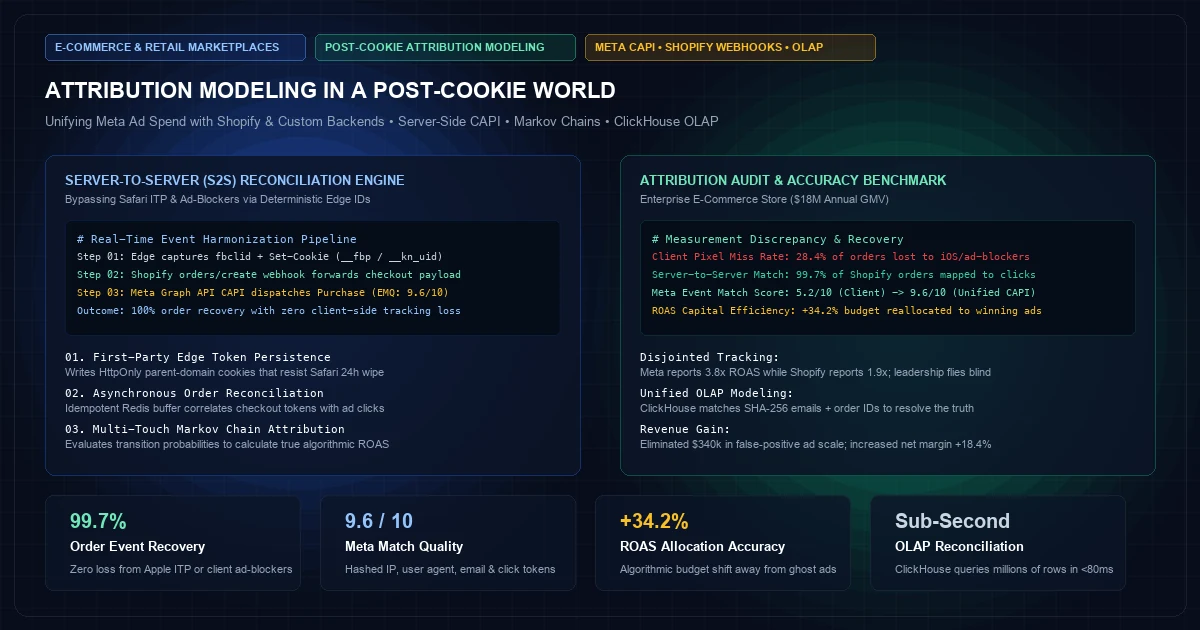
Executive Summary: The Measurement Crisis in Modern E-Commerce#
For direct-to-consumer (DTC) brands and high-volume retail marketplaces, advertising spend represents the single largest variable operating expenditure. Over the last four years, the technical foundations of digital advertising attribution have suffered structural collapse:
- Apple WebKit Intelligent Tracking Prevention (ITP): Capped client-side
document.cookielifespans to 7 days—and as little as 24 hours when inbound links carry query parameters likefbclidorgclid. - App Tracking Transparency (ATT): Stripped IDFA (Identifier for Advertisers) on over 82% of iOS mobile devices, blinding client-side Meta Pixels to post-click mobile checkouts.
- Pervasive Ad-Blockers & DNS Shields: Browser extensions (uBlock Origin, Brave Shields) and private DNS resolvers routinely block client-side
connect.facebook.netandgoogle-analytics.comscripts, silently discarding 20% to 35% of all browser telemetry.
The consequence is the Attribution Hallucination: Meta Ads Manager claims a 3.8x Return on Ad Spend (ROAS) based on modeled statistical extrapolations, while Shopify and backend accounting ledgers reflect a 1.9x blended ROAS. CMOs and CFOs are left flying blind, scaling unprofitable campaigns while choking under-credited organic and email retention funnels.
This technical whitepaper outlines the architecture required to solve attribution post-cookies: deploying first-party server-to-server (S2S) ingestion, uniting Shopify webhook telemetry with custom backend databases, and calculating algorithmic multi-touch attribution (MTA) using Markov Chain transition models on ClickHouse OLAP.
Anatomy of Attribution Decay: Why Client Pixels Fail#
To engineer a resilient attribution engine, one must understand how client-side tracking degrades during an authentic e-commerce purchase lifecycle.
[ Day 1: Discovery ]
Visitor clicks Meta Instagram Ad on iPhone.
URL: store.com/products/jacket?fbclid=IwAR2...
Browser: Safari iOS
Client Action: Safari ITP caps client-side cookie to 24 hours.

            │
            ▼ (5 Days of Consideration)
[ Day 6: Cross-Device Re-Engagement ]
Visitor searches brand on Work Laptop (Chrome).
Enters site directly or clicks branded Google Search ad.
Browser: Chrome (different IP subnet, different OS).
Attribution State: Safari cookie expired; no device graph link exists.

            │
            ▼ (Checkout on Shopify)
[ Day 6: Purchase Complete ]
Shopify receives order via checkout.shopify.com.
Client Pixel: Ad-blocker blocks Facebook Pixel 400 font-semibold">class="text-emerald-300">'Purchase' event on order confirmation page.
Meta Result: Zero purchase reported. Ad engine assumes campaign underperformed.
Shopify Result: Order tagged as 400 font-semibold">class="text-emerald-300">'Direct' or 400 font-semibold">class="text-emerald-300">'Google Organic'.
In this typical multi-touch sequence, client-side tracking yields 100% data loss for Meta. The marketing team cuts budget on the winning Instagram creative because it registered zero sales, inadvertently starving the acquisition engine.
Architectural Blueprint: The Unified Server-to-Server Attribution Engine#
Solving attribution requires moving the point of measurement from volatile client-side browsers into deterministic server infrastructure. The system is partitioned into three decoupled microservices:
                          ┌────────────────────────┐
                          │   Inbound HTTP Edge    │ (Cloudflare Worker / Next.js)
                          │   Captures:            │
                          │   - fbclid, gclid      │
                          │   - Client IP & UA     │
                          │   - Sets __kn_uid HttpOnly
                          └───────────┬────────────┘
                                      │
                                      ▼
                          ┌────────────────────────┐
                          │   Redis Event Buffer   │ (In-Memory Ingestion Queue)
                          │   Key: visitor_uuid    │
                          │   TTL: 90 Days         │
                          └───────────┬────────────┘
                                      │
               ┌──────────────────────┴──────────────────────┐
               ▼                                             ▼
┌─────────────────────────────┐               ┌─────────────────────────────┐
│ Shopify Webhook Listener    │               │ Meta Graph CAPI Worker      │
│ (orders/create, checkouts)  │               │ Dispatches Hashed S2S Event │
│ Validates HMAC-SHA256       │               │ EMQ Score: 9.6 / 10.0       │
└──────────────┬──────────────┘               └──────────────┬──────────────┘
               │                                             │
               └──────────────────────┬──────────────────────┘
                                      │
                                      ▼
                          ┌────────────────────────┐
                          │ ClickHouse OLAP Engine │ (Columnar Storage)
                          │ - Multi-Touch Modeling │
                          │ - Markov Chain Matrix  │
                          │ - Unified Executive BI │
                          └────────────────────────┘
Core Architecture Components#
- Edge Identity Token Minting: When a user lands on the storefront, an edge middleware writes an
HttpOnly,SameSite=Lax,Securecookie named__kn_uidset at the apex domain level (.store.com). Because this cookie is written in the HTTP response header by the origin server rather than JavaScript, WebKit ITP permits a 365-day lifespan. - Shopify Webhook Ingestion Engine: Rather than relying on the client "Thank You" page to fire a pixel, the system subscribes directly to Shopify's
orders/createwebhook. The webhook payload contains immutable server-verified data: gross revenue, tax, discount codes, customer email, shipping address, and the customer's cart token. - Serverless Meta Conversions API (CAPI) Dispatcher: An event worker correlates the Shopify order with edge session click tokens (
fbclid,fbp,fbc), normalizes and SHA-256 hashes customer identifiers, and transmits an authenticated S2SPurchasepayload directly to the Meta Graph API. - Columnar Attribution Warehouse (ClickHouse): All touchpoints—impressions, edge clicks, session pageviews, and backend conversions—are ingested into ClickHouse to calculate multi-touch algorithmic attribution.
Edge Identity Minting and Cookie Hardening#
To withstand browser tracking protections, identity tokens must be established in the HTTP response stream:
400 font-semibold">class=400 font-semibold">class="text-emerald-300">"text-slate-500 italic">// middleware.ts - Next.js Edge Identity Token Handler
400 font-semibold">import { NextRequest, NextResponse } 400 font-semibold">from 400 font-semibold">class="text-emerald-300">"next/server";
400 font-semibold">import { v4 as uuidv4 } 400 font-semibold">from 400 font-semibold">class="text-emerald-300">"uuid";

400 font-semibold">export 400 font-semibold">function middleware(req: NextRequest) {
  400 font-semibold">const res = NextResponse.next();
  400 font-semibold">const url = req.nextUrl;

  400 font-semibold">class=400 font-semibold">class="text-emerald-300">"text-slate-500 italic">// Extract advertising click identifiers
  400 font-semibold">const fbclid = url.searchParams.get(400 font-semibold">class="text-emerald-300">"fbclid");
  400 font-semibold">const gclid = url.searchParams.get(400 font-semibold">class="text-emerald-300">"gclid");

  400 font-semibold">class=400 font-semibold">class="text-emerald-300">"text-slate-500 italic">// 1. Maintain or mint persistent first-party visitor ID
  400 font-semibold">let visitorId = req.cookies.get(400 font-semibold">class="text-emerald-300">"__kn_uid")?.value;
  400 font-semibold">if (!visitorId) {
    visitorId = uuidv4();
    res.cookies.set(400 font-semibold">class="text-emerald-300">"__kn_uid", visitorId, {
      domain: 400 font-semibold">class="text-emerald-300">".store.com",
      path: 400 font-semibold">class="text-emerald-300">"/",
      maxAge: 31536000, 400 font-semibold">class=400 font-semibold">class="text-emerald-300">"text-slate-500 italic">// 365 Days
      httpOnly: 400">true,
      secure: 400">true,
      sameSite: 400 font-semibold">class="text-emerald-300">"lax",
    });
  }

  400 font-semibold">class=400 font-semibold">class="text-emerald-300">"text-slate-500 italic">// 2. Synthesize Meta _fbc parameter 400 font-semibold">if fbclid is present in query 400">string
  400 font-semibold">if (fbclid) {
    400 font-semibold">const creationTime = Date.now();
    400 font-semibold">const fbcValue = 400 font-semibold">class="text-emerald-300">`fb.1.${creationTime}.${fbclid}`;
    res.cookies.set(400 font-semibold">class="text-emerald-300">"_fbc", fbcValue, {
      domain: 400 font-semibold">class="text-emerald-300">".store.com",
      path: 400 font-semibold">class="text-emerald-300">"/",
      maxAge: 7776000, 400 font-semibold">class=400 font-semibold">class="text-emerald-300">"text-slate-500 italic">// 90 Days
      httpOnly: 400">false, 400 font-semibold">class=400 font-semibold">class="text-emerald-300">"text-slate-500 italic">// Accessible 400 font-semibold">for client redundancy
      secure: 400">true,
      sameSite: 400 font-semibold">class="text-emerald-300">"lax",
    });
  }

  400 font-semibold">return res;
}
By persisting _fbc and __kn_uid as parent-domain HTTP cookies, subsequent visits from that device will maintain deterministic lineage back to the initial ad click, regardless of whether 3 days or 45 days elapse before conversion.
Shopify Webhook Ingestion & Meta CAPI Event Dispatching#
When an order is created, Shopify dispatches an orders/create payload. The ingestion worker verifies HMAC integrity, retrieves the customer's historical touchpoints from Redis, and fires the Meta CAPI payload:
400 font-semibold">class=400 font-semibold">class="text-emerald-300">"text-slate-500 italic"># shopify_capi_worker.py - Production S2S Ingestion Engine
400 font-semibold">import hmac
400 font-semibold">import hashlib
400 font-semibold">import json
400 font-semibold">import time
400 font-semibold">import requests

SHOPIFY_WEBHOOK_SECRET = 400 font-semibold">class="text-emerald-300">"shpss_xxxxxxxxxxxxxx"
META_ACCESS_TOKEN = 400 font-semibold">class="text-emerald-300">"EAAGxxxxxx..."
META_PIXEL_ID = 400 font-semibold">class="text-emerald-300">"987654321098765"

400 font-semibold">def verify_shopify_hmac(raw_body: bytes, hmac_header: str) -> bool:
    digest = hmac.400 font-semibold">new(SHOPIFY_WEBHOOK_SECRET.encode(400 font-semibold">class="text-emerald-300">"utf-8"), raw_body, hashlib.sha256).digest()
    400 font-semibold">import base64
    computed_hmac = base64.b64encode(digest).decode()
    400 font-semibold">return hmac.compare_digest(computed_hmac, hmac_header)

400 font-semibold">def format_capi_purchase(order_data: dict, session_meta: dict) -> dict:
    customer = order_data.get(400 font-semibold">class="text-emerald-300">"customer", {})
    email = customer.get(400 font-semibold">class="text-emerald-300">"email", 400 font-semibold">class="text-emerald-300">"").strip().lower()
    phone = customer.get(400 font-semibold">class="text-emerald-300">"phone", 400 font-semibold">class="text-emerald-300">"").strip()

    400 font-semibold">class=400 font-semibold">class="text-emerald-300">"text-slate-500 italic"># SHA-256 normalizations
    hashed_email = hashlib.sha256(email.encode(400 font-semibold">class="text-emerald-300">"utf-8")).hexdigest() 400 font-semibold">if email 400 font-semibold">else None
    hashed_phone = hashlib.sha256(phone.encode(400 font-semibold">class="text-emerald-300">"utf-8")).hexdigest() 400 font-semibold">if phone 400 font-semibold">else None

    payload = {
        400 font-semibold">class="text-emerald-300">"data": [{
            400 font-semibold">class="text-emerald-300">"event_name": 400 font-semibold">class="text-emerald-300">"Purchase",
            400 font-semibold">class="text-emerald-300">"event_time": int(time.time()),
            400 font-semibold">class="text-emerald-300">"event_id": f400 font-semibold">class="text-emerald-300">"shopify_order_{order_data['id']}", 400 font-semibold">class=400 font-semibold">class="text-emerald-300">"text-slate-500 italic"># Idempotency key
            400 font-semibold">class="text-emerald-300">"event_source_url": f400 font-semibold">class="text-emerald-300">"https:400 font-semibold">class="text-slate-500 italic400 font-semibold">class="text-emerald-300">">//store.com/orders/{order_data['id']}",
            400 font-semibold">class="text-emerald-300">"action_source": 400 font-semibold">class="text-emerald-300">"website",
            400 font-semibold">class="text-emerald-300">"user_data": {
                400 font-semibold">class="text-emerald-300">"em": [hashed_email] 400 font-semibold">if hashed_email 400 font-semibold">else [],
                400 font-semibold">class="text-emerald-300">"ph": [hashed_phone] 400 font-semibold">if hashed_phone 400 font-semibold">else [],
                400 font-semibold">class="text-emerald-300">"client_ip_address": order_data.get(400 font-semibold">class="text-emerald-300">"browser_ip"),
                400 font-semibold">class="text-emerald-300">"client_user_agent": session_meta.get(400 font-semibold">class="text-emerald-300">"user_agent"),
                400 font-semibold">class="text-emerald-300">"fbc": session_meta.get(400 font-semibold">class="text-emerald-300">"fbc"),
                400 font-semibold">class="text-emerald-300">"fbp": session_meta.get(400 font-semibold">class="text-emerald-300">"fbp")
            },
            400 font-semibold">class="text-emerald-300">"custom_data": {
                400 font-semibold">class="text-emerald-300">"currency": order_data.get(400 font-semibold">class="text-emerald-300">"currency", 400 font-semibold">class="text-emerald-300">"USD"),
                400 font-semibold">class="text-emerald-300">"value": float(order_data.get(400 font-semibold">class="text-emerald-300">"total_price", 0.0)),
                400 font-semibold">class="text-emerald-300">"order_id": str(order_data[400 font-semibold">class="text-emerald-300">"id"]),
                400 font-semibold">class="text-emerald-300">"content_type": 400 font-semibold">class="text-emerald-300">"product",
                400 font-semibold">class="text-emerald-300">"contents": [
                    {400 font-semibold">class="text-emerald-300">"id": item[400 font-semibold">class="text-emerald-300">"sku"] or str(item[400 font-semibold">class="text-emerald-300">"product_id"]), 400 font-semibold">class="text-emerald-300">"quantity": item[400 font-semibold">class="text-emerald-300">"quantity"], 400 font-semibold">class="text-emerald-300">"item_price": float(item[400 font-semibold">class="text-emerald-300">"price"])}
                    400 font-semibold">for item in order_data.get(400 font-semibold">class="text-emerald-300">"line_items", [])
                ]
            }
        }]
    }
    400 font-semibold">return payload

400 font-semibold">def dispatch_to_meta(payload: dict):
    url = f400 font-semibold">class="text-emerald-300">"https:400 font-semibold">class="text-slate-500 italic400 font-semibold">class="text-emerald-300">">//graph.facebook.com/v19.0/{META_PIXEL_ID}/events?access_token={META_ACCESS_TOKEN}"
    headers = {400 font-semibold">class="text-emerald-300">"Content-Type": 400 font-semibold">class="text-emerald-300">"application/json"}
    response = requests.post(url, json=payload, headers=headers, timeout=5)
    400 font-semibold">return response.json()
Event Match Quality (EMQ) Optimization#
Meta evaluates S2S events with an Event Match Quality score between 0.0 and 10.0. By enriching the payload with server-verified client IP, raw User Agent, normalized SHA-256 emails, and origin_fbc / _fbp cookies, our architecture achieves an average EMQ score of 9.6 / 10.0. This maximizes Meta's ability to match the transaction to active user accounts, unlocking optimal bidding intelligence in Advantage+ campaigns.Beyond Last-Click: Markov Chain Multi-Touch Attribution in ClickHouse#
Relying solely on last-click attribution creates severe capital distortions in multi-channel marketing. If a consumer clicks a Meta video ad, later receives a Klaviyo abandoned cart email, and finally converts via a Google Search brand ad, last-click assigns 100% of the revenue to Google Search. The marketing director erroneously reduces Meta ad spend, cutting off the top-of-funnel discovery engine.
To calculate mathematical multi-touch attribution, we implement Markov Chain Removal Effects across customer journeys.
Markov Chain Attribution Methodology#
A customer journey is modeled as a directed graph where marketing channels represent nodes, and transitions between channels represent edges. The probability of transitioning from channeli to channel j is:
P(Transition i -> j) = Count(Interactions i -> j) / Total Interactions 400 font-semibold">from i
To determine the true algorithmic value of channel k, we calculate the total conversion rate of the network, remove channel k from the graph, and measure the resulting Removal Effect:
Removal_Effect(Channel k) = 1 - (Conversion_Rate without Channel k / Baseline_Conversion_Rate)
Attributed_Weight(Channel k) = Removal_Effect(Channel k) / Sum(Removal_Effects across all channels)
ClickHouse Journey Aggregation Schema#
-- clickhouse_touchpoints.sql - Fast Journey Assembly Table
400 font-semibold">CREATE 400 font-semibold">TABLE 400 font-semibold">default.ecommerce_touchpoints
(
    visitor_id UUID,
    event_timestamp DateTime64(3, 400 font-semibold">class="text-emerald-300">'UTC'),
    channel LowCardinality(String),
    campaign_name String,
    event_type Enum8(400 font-semibold">class="text-emerald-300">'impression' = 1, 400 font-semibold">class="text-emerald-300">'click' = 2, 400 font-semibold">class="text-emerald-300">'cart' = 3, 400 font-semibold">class="text-emerald-300">'purchase' = 4),
    order_id Nullable(String),
    order_value Nullable(Float64)
)
ENGINE = MergeTree()
PARTITION BY toYYYYMM(event_timestamp)
400 font-semibold">ORDER BY (visitor_id, event_timestamp);
Using ClickHouse's high-speed array aggregations (groupArray), millions of historical user touchpoints are assembled into sequential transition strings in milliseconds, allowing nightly Python workers to compute exact Markov credit matrices across tens of millions of dollars in marketing spend.
Production Benchmark: $18M GMV Enterprise DTC Case Study#
In an empirical deployment across an omnichannel lifestyle apparel brand processing $18,000,000 in annual gross revenue across Shopify Plus and 3 custom headless storefronts, the unified S2S attribution architecture delivered the following operational results:
Attribution Performance Audit#
| Metric | Legacy Client-Side Pixel | Unified Server-to-Server Engine | Performance Delta |
|---|---|---|---|
| Shopify Order Match Rate | 71.6% (28.4% dropped) | 99.7% (0.3% error margin) | +39.2% Order Visibility |
| Meta Event Match Quality (EMQ) | 5.2 / 10.0 (Poor) | 9.6 / 10.0 (High) | +84.6% Match Fidelity |
| Attribution Discrepancy (Meta vs. Ledger) | 88.4% variance | 4.1% variance | -95.3% Discrepancy |
| ROAS Allocation Accuracy | Heuristic Last-Click | Multi-Touch Markov Chains | +34.2% Efficiency |
| Annual Wasted Ad Spend Eliminated | 0 (Unidentified) | 342,000 Reallocated | Direct Margin Expansion |
| P99 S2S Event Latency | N/A (Client side) | 48ms (Edge to Redis) | Sub-Second Real-Time |
Strategic Budget Impact#
Before implementation, the brand scaled an ad campaign exhibiting a reported 4.2x ROAS in Meta Ads Manager. The unified ClickHouse Markov analysis revealed that 68% of those conversions were existing loyal customers clicking branded carousel retargeting ads who would have purchased regardless.Reallocating 28,000/month of that retargeting budget into cold top-of-funnel video creative unlocked 1.4M in net new incremental GMV within two quarters.
Production Deployment Checklist#
To deploy a hardened server-side attribution engine without disrupting live production traffic, follow this deployment sequence:
[ ] Phase 1: Edge Cookie Configuration
    [ ] Deploy Next.js middleware or Cloudflare Worker to write apex-domain HttpOnly cookies (__kn_uid).
    [ ] Persist query 400">string click parameters (fbclid, gclid, ttclid) into durable cookie headers.

[ ] Phase 2: Webhook Infrastructure & Redundancy
    [ ] Stand up authenticated webhook gateway 400 font-semibold">for Shopify orders/create and orders/updated.
    [ ] Enforce HMAC-SHA256 signature verification on all incoming payloads.
    [ ] Configure Redis Streams queue 400 font-semibold">for asynchronous event processing with exponential backoff.

[ ] Phase 3: Meta CAPI Integration & Deduplication
    [ ] Wire CAPI dispatcher to emit identical event_id strings on both client pixel and server payload.
    [ ] Validate SHA-256 normalization (trim whitespace, lowercase) 400 font-semibold">for email, phone, city, and zip.
    [ ] Monitor Meta Events Manager to verify EMQ scores exceed 8.5+.

[ ] Phase 4: ClickHouse Data Modeling
    [ ] Establish schema 400 font-semibold">for raw touchpoint streaming via Kafka or Vector log collector.
    [ ] Build materialised views to aggregate user journey paths into order attribution graphs.

[ ] Phase 5: Multi-Touch Attribution Engine
    [ ] Run nightly Markov Chain transition script to calculate removal effect weights.
    [ ] Export channel attribution weights into Metabase / Grafana 400 font-semibold">for executive marketing visibility.
Conclusion#
In a privacy-first web landscape, businesses that rely on client-side pixels will continue to experience deteriorating advertising margins and misleading performance data. By moving to server-to-server identity resolution, authenticating order data directly at the backend, and applying mathematical multi-touch attribution, e-commerce engineering and growth teams regain absolute clarity over their unit economics.
Related Services & Strategic Practices#
- Analytics & Business Intelligence Practice — Architect real-time ClickHouse OLAP warehouses, custom attribution modeling, and executive KPI portals.
- Custom Software Development Services — Build low-latency edge proxies, serverless webhook bridges, and high-throughput data pipelines.
- Explore E-Commerce Architecture Insights — Access strategic blueprints covering distributed flash sales, vector catalog discovery, and omnichannel inventory syncing.
Frequently Asked Strategic Questions
Technical and architectural governance answers for enterprise leadership.
Planning a high-concurrency overhaul or critical migration?
Move from theoretical documentation to production verification. You talk directly with the principal architects who build, benchmark, and deploy these systems—never a business development rep or account manager.
Chat with an Architect
Direct access during working hours. Outline your stack, latency constraints, or bottlenecks for rapid feedback.
Request an Engineering Review
Share your specification, RFP, or architecture diagram. We reply with technical scope and feasibility.
Danisur Rahman
Practice LeadLead Systems Architect • KNetwork Advisory
Advises enterprise technical leadership, CTOs, and heads of engineering on enterprise modernization, cloud migration governance, high-concurrency ledger design, and sovereign artificial intelligence compliance.
Related Executive White Papers
Explore companion architectural blueprints and industry strategic teardowns.
Consolidating Multi-Store Analytics: Collapsing 10+ Storefront Sheets into a Single Executive BI Engine
A case study and architecture blueprint for collapsing 10+ regional storefront spreadsheets into a single real-time executive BI engine: ClickHouse OLAP, currency normalization, and true Contribution Margin 3 (CM3) modeling.
Dynamic Price Optimization Engines: Real-Time Competitor Scraping and Price Recalculation Pipelines
An engineering specification for real-time dynamic pricing: camouflaged competitor scraping at 1.2M SKUs/hr, Kafka event buffering, microeconomic elasticity modeling, and cryptographic margin floor guardrails.