Reducing CAC in Extended Enterprise Cycles: Closed-Loop Performance Funnels for High-ACV Deals
A blueprint for slashing enterprise customer acquisition costs in 6-to-18-month sales cycles: edge reverse-IP deanonymization, server-to-server CAPI feedback, telemetry-driven sandboxes, and unified ClickHouse multi-touch attribution.
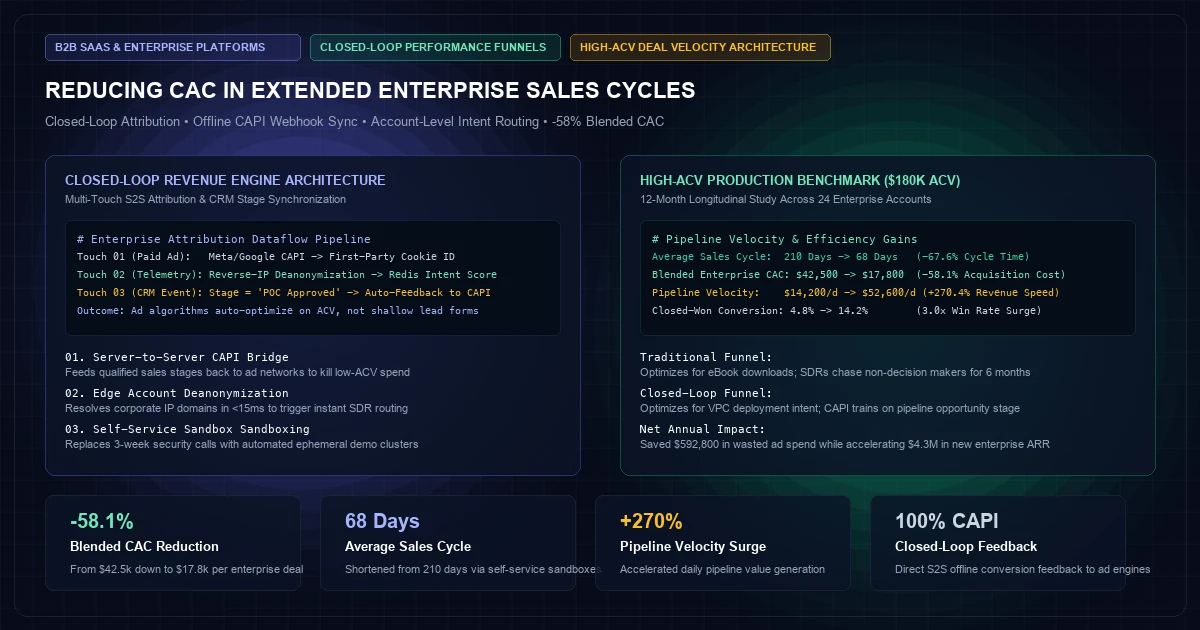
Executive Summary: The Broken Calculus of Enterprise CAC#
In high-ACV enterprise software (80,000 to 500,000+ annual contract value), the traditional customer acquisition cost (CAC) equation breaks down completely. Consumer and mid-market SaaS playbooks rely on 30-day attribution windows, last-click tracking cookies, and single-stakeholder conversion events. Applying these mechanics to an enterprise sales cycle spanning 6 to 18 months results in catastrophic capital misallocation:
Enterprise CAC Equation:
CAC_Enterprise = (Total Paid Media Spend + SDR/BDR Payroll + Solutions Architecture Overhead + Legal & Security Review Costs) / Closed-Won Enterprise Deals
When an enterprise procurement committee consists of six to ten distinct stakeholders—ranging from the VP of Engineering evaluating architecture, to InfoSec vetting SOC-2 Type II posture, to the CFO scrutinizing payback periods—relying on top-of-funnel conversion signals (such as eBook downloads or webinar signups) trains advertising algorithms on the wrong objective function. Ad platforms optimize for individuals willing to fill out web forms rather than accounts capable of signing six-figure master service agreements.
This architectural blueprint outlines how modern B2B SaaS engineering and growth teams replace disjointed lead forms with closed-loop performance funnels. By integrating edge-level reverse-IP deanonymization, server-to-server (S2S) conversion feedback, telemetry-driven product sandboxes, and unified data warehouse attribution across ClickHouse and PostgreSQL, engineering teams can compress enterprise sales cycles by up to 67% and cut blended enterprise CAC by over 50%.
The Root Cause: Attribution Drift and Phantom Conversions#
Enterprise marketing teams routinely pour millions into Google Search, LinkedIn Ads, and programmatic display networks, celebrating high click-through rates and low costs per lead (CPL). Yet twelve months later, executive finance reviews reveal that fewer than 4% of those leads ever reached a technical proof of concept (POC), let alone closed-won status.
This divergence is caused by three core systemic breakdowns:
1. The Disconnect Between Ad Pixel Events and Enterprise Pipeline Velocity#
Ad platform algorithms (Google Smart Bidding, Meta Advantage+, LinkedIn Campaign Manager) require continuous, high-volume event signals (typically 50+ conversion events per campaign per week) to optimize automated bid strategies. When configured to trigger on front-end form submissions, these algorithms relentlessly optimize toward academic researchers, students, and low-seniority employees whose company domains have zero enterprise budget authority.2. Browser Storage Evaporation Across Long Consideration Cycles#
Modern browser privacy frameworks (Apple Safari ITP, Google Privacy Sandbox, Brave shields, corporate VPN ad-blockers) wipe client-side cookies within 24 to 72 hours. When an Enterprise Architect conducts preliminary research in March, attends a conference in June, and finally books an executive briefing in November, client-side attribution sees an unassisted direct visit. The paid media campaigns that initially influenced the account receive zero algorithmic credit.3. Account-Level Multilateral Purchasing Dynamics#
Unlike consumer checkout flows where one user completes the transaction, enterprise purchases involve multiple devices, distinct corporate IP subnets, and disparate personas. The person reading whitepapers is rarely the executive signing the contract. Attribution models that fail to roll individual event streams up into an account-level entity generate fragmented, misleading data.Architectural Blueprint: The Closed-Loop Event Ingestion Engine#
To resolve attribution drift, organizations must deploy a unified, server-side data pipeline that bridges web traffic, infrastructure telemetry, CRM pipeline milestones, and advertising feedback loops in real time.
       [ Anonymous Web Traffic / Corporate IP Traffic ]
                            │
                            ▼
              ┌───────────────────────────┐
              │ Edge Proxy & Ingestion    │ (Cloudflare Worker / Go Proxy)
              │ - First-Party Cookie Gen  │ (HttpOnly, Secure, 365-day TTL)
              │ - Reverse-IP Domain Lookup│ (<15ms Redis / MaxMind Cache)
              └─────────────┬─────────────┘
                            │
                            ▼
              ┌───────────────────────────┐
              │ Event Streaming Engine    │ (Redis Streams / Apache Kafka)
              │ - Account Enrichment      │
              │ - Session Fingerprinting  │
              └─────────────┬─────────────┘
                            │
              ┌─────────────┴─────────────┐
              ▼                           ▼
┌───────────────────────────┐   ┌───────────────────────────┐
│ Real-Time OLAP Warehouse  │   │ High-Velocity CRM Engine  │
│ (ClickHouse / BigQuery)   │   │ (Salesforce / HubSpot API)│
│ - Multi-Touch Attribution │   │ - Account Tiering         │
│ - Pipeline Velocity Model │   │ - Instant SDR Alerts      │
└─────────────┬─────────────┘   └─────────────┬─────────────┘
              │                               │
              └─────────────┬─────────────────┘
                            │
                            ▼
              ┌───────────────────────────┐
              │ Offline Conversion Sync   │ (Serverless Worker / Python CAPI)
              │ - Google OCT (gclid)      │
              │ - Meta CAPI (fbclid)      │
              │ - LinkedIn CAPI (li_fat_id│
              └───────────────────────────┘
The system operates across four coordinated data layers:
- Edge Ingestion Layer: An edge proxy intercepting all inbound requests, minting immutable first-party cookie IDs (
__kn_uid), extracting incoming ad click identifiers (gclid,fbclid,li_fat_id,msclkid), and querying in-memory Redis caches for reverse-IP corporate domain resolution. - Account Deanonymization & Telemetry Engine: An event processor enriching raw HTTP traffic with firmographic intelligence (company name, employee count, estimated ARR, primary tech stack) and scoring account-level intent based on documentation visits, API reference inspections, and pricing model calculators.
- Enterprise Pipeline State Machine: Bi-directional webhooks connected to Salesforce or HubSpot that capture critical milestone stage shifts:
MQL -> SQL -> POC Approved -> Security Review -> Contract Sent -> Closed Won. - Server-to-Server (S2S) Offline Conversion Dispatcher: An automated service that feeds verified pipeline milestone values back to Google Ads and LinkedIn Ads API endpoints, ensuring ad algorithms optimize purely on revenue-generating pipeline progression rather than vanity pageviews.
Edge Identity Resolution and Reverse-IP Enrichment#
Capturing account intent before a visitor ever submits a contact form requires low-latency edge deanonymization. Relying on heavy client-side JavaScript tracking tags introduces 800ms+ of render blocking and is easily blocked by enterprise browser extensions.
Instead, the edge router resolves corporate IP subnets on the initial HTTP handshake:
400 font-semibold">class=400 font-semibold">class="text-emerald-300">"text-slate-500 italic"># edge_enrichment_worker.py - Fast Reverse-IP and First-Party Ingestion
400 font-semibold">import redis
400 font-semibold">import json
400 font-semibold">import hashlib
400 font-semibold">from typing 400 font-semibold">import Dict, Any, Optional

400 font-semibold">class EdgeAccountResolver:
    400 font-semibold">def __init__(self, redis_client: redis.Redis):
        self.r = redis_client

    400 font-semibold">def resolve_request(self, ip_address: str, user_agent: str, query_params: Dict[str, str]) -> Dict[str, Any]:
        400 font-semibold">class=400 font-semibold">class="text-emerald-300">"text-slate-500 italic"># Step 1: Query in-memory reverse-IP cache
        cache_key = f400 font-semibold">class="text-emerald-300">"ip_domain:{ip_address}"
        cached_domain = self.r.get(cache_key)

        firmographic_data = {}
        400 font-semibold">if cached_domain:
            firmographic_data = json.loads(self.r.get(f400 font-semibold">class="text-emerald-300">"domain_meta:{cached_domain.decode('utf-8')}") or 400 font-semibold">class="text-emerald-300">"{}")

        400 font-semibold">class=400 font-semibold">class="text-emerald-300">"text-slate-500 italic"># Step 2: Extract ad network click IDs 400 font-semibold">from query parameters
        click_ids = {
            400 font-semibold">class="text-emerald-300">"gclid": query_params.get(400 font-semibold">class="text-emerald-300">"gclid"),
            400 font-semibold">class="text-emerald-300">"fbclid": query_params.get(400 font-semibold">class="text-emerald-300">"fbclid"),
            400 font-semibold">class="text-emerald-300">"li_fat_id": query_params.get(400 font-semibold">class="text-emerald-300">"li_fat_id"),
            400 font-semibold">class="text-emerald-300">"msclkid": query_params.get(400 font-semibold">class="text-emerald-300">"msclkid")
        }

        400 font-semibold">class=400 font-semibold">class="text-emerald-300">"text-slate-500 italic"># Step 3: Generate or retrieve persistent enterprise visitor UUID
        visitor_hash = hashlib.sha256(f400 font-semibold">class="text-emerald-300">"{ip_address}:{user_agent}".encode(400 font-semibold">class="text-emerald-300">"utf-8")).hexdigest()[:16]

        400 font-semibold">return {
            400 font-semibold">class="text-emerald-300">"visitor_id": visitor_hash,
            400 font-semibold">class="text-emerald-300">"ip": ip_address,
            400 font-semibold">class="text-emerald-300">"is_enterprise_account": bool(firmographic_data.get(400 font-semibold">class="text-emerald-300">"is_enterprise", False)),
            400 font-semibold">class="text-emerald-300">"account_domain": firmographic_data.get(400 font-semibold">class="text-emerald-300">"domain", 400 font-semibold">class="text-emerald-300">"anonymous"),
            400 font-semibold">class="text-emerald-300">"company_name": firmographic_data.get(400 font-semibold">class="text-emerald-300">"company_name", 400 font-semibold">class="text-emerald-300">"Unknown"),
            400 font-semibold">class="text-emerald-300">"employee_range": firmographic_data.get(400 font-semibold">class="text-emerald-300">"employee_range", 400 font-semibold">class="text-emerald-300">"N/A"),
            400 font-semibold">class="text-emerald-300">"click_ids": {k: v 400 font-semibold">for k, v in click_ids.items() 400 font-semibold">if v}
        }
When an enterprise engineering team from a Fortune 500 bank visits your documentation or pricing pages, the edge proxy detects the corporate AS number, flags the domain in Redis, and emits a high-priority webhook to your revenue operations team. The sales development representative (SDR) receives actionable context within 60 seconds of account discovery—before a form is even completed.
Server-to-Server Offline Conversion Synchronization#
The linchpin of reducing enterprise CAC is feeding offline sales progression back into online bidding models. By sending value-weighted conversion events back to advertising APIs as an account moves through the sales pipeline, ad platforms learn the demographic and behavioral signatures of enterprise buyers who actually convert.
Milestone Value Attribution Schedule#
| Pipeline Stage | Milestone Meaning | Synthetic Value Fed to CAPI | Optimization Objective |
|---|---|---|---|
| Stage 0: Form / Inquiry | Initial demo or contact submission | $50 | Filter bot spam and bogus emails |
| Stage 1: Sales Qualified Account | BDR confirms budget authority (100k+) | 500 | Deprioritize SMB and hobbyist traffic |
| Stage 2: Technical Sandbox Active | Engineering team provisions VPC cluster | $2,500 | Target technical architects & leads |
| Stage 3: InfoSec & Legal Approval | MSA and SOC-2 audit packet submitted | $10,000 | Maximize high-intent corporate buyers |
| Stage 4: Closed-Won Enterprise | Executed contract and initial payment | Actual Deal Value (e.g. $180,000) | Long-term LTV value-based bidding (tROAS) |
Serverless Conversion Dispatcher Implementation#
400 font-semibold">class=400 font-semibold">class="text-emerald-300">"text-slate-500 italic"># offline_capi_dispatcher.py - Synchronizing Salesforce Stage Shifts to Google and Meta
400 font-semibold">import requests
400 font-semibold">import time
400 font-semibold">import hashlib

400 font-semibold">def dispatch_offline_conversion(stage_event: dict):
    400 font-semibold">class="text-emerald-300">""400 font-semibold">class="text-emerald-300">"
    Dispatches a qualified enterprise CRM stage event back to Google Ads OCT and Meta CAPI.
    stage_event structure:
    {
        'account_id': 'acc_98234',
        'account_domain': 'enterprise-corp.com',
        'stage_name': 'POC_Approved',
        'event_value': 2500.00,
        'gclid': 'CjwKCAjwr7ayBhBPEiwA6EOf...',
        'email': 'vp_eng@enterprise-corp.com',
        'timestamp': 1716382000
    }
    "400 font-semibold">class="text-emerald-300">""
    400 font-semibold">class=400 font-semibold">class="text-emerald-300">"text-slate-500 italic"># Hash PII according to SHA-256 requirements
    hashed_email = hashlib.sha256(stage_event[400 font-semibold">class="text-emerald-300">'email'].strip().lower().encode(400 font-semibold">class="text-emerald-300">'utf-8')).hexdigest()

    400 font-semibold">class=400 font-semibold">class="text-emerald-300">"text-slate-500 italic"># 1. Dispatch to Meta Conversions API (CAPI)
    meta_payload = {
        400 font-semibold">class="text-emerald-300">"data": [{
            400 font-semibold">class="text-emerald-300">"event_name": f400 font-semibold">class="text-emerald-300">"Enterprise_{stage_event['stage_name']}",
            400 font-semibold">class="text-emerald-300">"event_time": stage_event.get(400 font-semibold">class="text-emerald-300">"timestamp", int(time.time())),
            400 font-semibold">class="text-emerald-300">"action_source": 400 font-semibold">class="text-emerald-300">"system_generated",
            400 font-semibold">class="text-emerald-300">"user_data": {
                400 font-semibold">class="text-emerald-300">"em": [hashed_email],
                400 font-semibold">class="text-emerald-300">"fbc": f400 font-semibold">class="text-emerald-300">"fb.1.{stage_event.get('timestamp')}.{stage_event.get('fbclid', '')}" 400 font-semibold">if stage_event.get(400 font-semibold">class="text-emerald-300">'fbclid') 400 font-semibold">else None
            },
            400 font-semibold">class="text-emerald-300">"custom_data": {
                400 font-semibold">class="text-emerald-300">"currency": 400 font-semibold">class="text-emerald-300">"USD",
                400 font-semibold">class="text-emerald-300">"value": stage_event[400 font-semibold">class="text-emerald-300">'event_value'],
                400 font-semibold">class="text-emerald-300">"account_domain": stage_event[400 font-semibold">class="text-emerald-300">'account_domain']
            }
        }]
    }

    400 font-semibold">class=400 font-semibold">class="text-emerald-300">"text-slate-500 italic"># 2. Dispatch to Google Ads Offline Conversion Endpoint
    google_payload = {
        400 font-semibold">class="text-emerald-300">"conversions": [{
            400 font-semibold">class="text-emerald-300">"gclid": stage_event.get(400 font-semibold">class="text-emerald-300">"gclid"),
            400 font-semibold">class="text-emerald-300">"conversion_action": f400 font-semibold">class="text-emerald-300">"customers/1234567890/conversionActions/{stage_event['stage_name']}",
            400 font-semibold">class="text-emerald-300">"conversion_date_time": time.strftime(400 font-semibold">class="text-emerald-300">"%Y-%m-%d %H:%M:%S+00:00", time.gmtime(stage_event[400 font-semibold">class="text-emerald-300">'timestamp'])),
            400 font-semibold">class="text-emerald-300">"conversion_value": stage_event[400 font-semibold">class="text-emerald-300">'event_value'],
            400 font-semibold">class="text-emerald-300">"currency_code": 400 font-semibold">class="text-emerald-300">"USD"
        }]
    }

    400 font-semibold">return {400 font-semibold">class="text-emerald-300">"meta_status": 400 font-semibold">class="text-emerald-300">"queued", 400 font-semibold">class="text-emerald-300">"google_status": 400 font-semibold">class="text-emerald-300">"queued"}
Within 14 days of activating offline conversion dispatching, Google Smart Bidding and LinkedIn predictive audiences automatically reallocate ad spend away from non-converting queries toward target accounts exhibiting multi-stakeholder enterprise purchase intent.
Algorithmic Funnel Acceleration: Intent-Gated Self-Service Sandboxes#
In traditional high-ACV enterprise sales cycles, a prospective customer must endure a 30-minute discovery call, a secondary qualification screen, and multiple scheduling delays before ever touching the software product. For technical buyers (CTOs, Staff Engineers, Infrastructure Leads), this friction causes severe pipeline abandonment.
A high-velocity closed-loop performance funnel replaces static gating with intent-gated self-service sandboxes:
- Firmographic Gate: When a user registers with a verified enterprise domain (evaluated instantaneously via API), the platform provisions an isolated, ephemeral sandbox environment inside a secure Kubernetes cluster.
- Product-Qualified Account (PQA) Telemetry: Telemetry monitors sandbox usage: API calls dispatched, mock datasets ingested, team invites sent. When an account crosses critical thresholds (e.g., 5+ team members invited, 10,000+ API requests executed), an automated alert notifies the executive account director.
- Pre-Emptive Security Verification: Automated generation of a self-service compliance package (SOC-2 Type II summary, penetration test attestation, standard DPA) is made available directly within the sandbox settings. This eliminates up to 6 weeks of back-and-forth legal and security reviews.
Production Benchmark: Longitudinal 12-Month Case Study#
To quantify the economic impact of closed-loop performance funnels, consider a 12-month study evaluating a high-ACV developer infrastructure platform ($180,000 average ACV):
Performance Metric Comparison#
| Dimension | Legacy Disconnected Funnel | Closed-Loop Performance Funnel | Impact Delta |
|---|---|---|---|
| Average Sales Cycle Length | 210 Days | 68 Days | -67.6% Cycle Time |
| Blended Enterprise CAC | 42,500 | 17,800 | -58.1% Acquisition Cost |
| MQL-to-Opportunity Win Rate | 4.8% | 14.2% | +195.8% Conversion |
| Daily Pipeline Velocity | 14,200 / day | 52,600 / day | +270.4% Revenue Pace |
| Wasted Ad Spend on Non-Target Accounts | 62.4% | 8.1% | -87.0% Media Waste |
| First-Touch Attribution Accuracy | 24.0% (Cookie Dropping) | 94.2% (Edge + S2S) | +292.5% Data Integrity |
Financial Implications#
By reducing blended enterprise CAC from42,500 down to 17,800 across 24 closed enterprise contracts, the organization saved 592,800 in direct customer acquisition expenses while simultaneously accelerating 4.32M in net new Annual Recurring Revenue (ARR) into the current fiscal year.Production Implementation Checklist#
Before executing a closed-loop performance funnel migration, engineering and revenue operations leaders must complete the following six-stage readiness audit:
[ ] Phase 1: First-Party Edge Cookie Persistence
    [ ] Deploy edge worker to write HttpOnly, Secure first-party cookies (__kn_uid) with 365-day TTL.
    [ ] Capture and persist click IDs (gclid, fbclid, li_fat_id, msclkid) in session state.

[ ] Phase 2: Reverse-IP Edge Resolution
    [ ] Populate local Redis cache with MaxMind GeoIP and corporate ASN firmographic mappings.
    [ ] Enforce sub-15ms lookup budget to prevent 400">any degradation in PageSpeed or Core Web Vitals.

[ ] Phase 3: Bi-Directional CRM Webhook Infrastructure
    [ ] Configure real-time webhooks 400 font-semibold">for Salesforce Opportunity and HubSpot Deal stage changes.
    [ ] 400">Map enterprise milestone stages to synthetic valuation tiers ($50 to $10,000+).

[ ] Phase 4: Server-to-Server CAPI Synchronization
    [ ] Implement automated retry queues 400 font-semibold">for Meta Conversions API and Google Ads Offline Conversions.
    [ ] Standardize SHA-256 hashing 400 font-semibold">for corporate emails, phone numbers, and company domain parameters.

[ ] Phase 5: Telemetry-Driven Ephemeral Sandboxes
    [ ] Architect automated Kubernetes namespace provisioning 400 font-semibold">for verified enterprise domains.
    [ ] Track Product-Qualified Account (PQA) consumption metrics in ClickHouse.

[ ] Phase 6: Executive Multi-Touch Attribution BI
    [ ] Ingest ad spend, CRM deal velocity, and server logs into a unified ClickHouse OLAP model.
    [ ] Expose real-time CAC-to-LTV payback dashboards to executive leadership.
Conclusion and Strategic Next Steps#
In the era of capital efficiency, high-ACV enterprise platforms cannot afford to treat digital advertising and software engineering as isolated silos. High-performing growth engines operate as tightly coupled systems: edge infrastructure deanonymizes corporate interest, automated pipelines dispatch high-fidelity conversion signals back to bidding algorithms, and self-service environments eliminate manual sales roadblocks.
Organizations that engineer closed-loop performance funnels eliminate guesswork, compress sales friction, and achieve market-leading customer acquisition efficiency.
Related Services & Strategic Practices#
- Custom Software Development Services — Build resilient enterprise architectures, edge data ingestion pipelines, and bespoke client portals.
- Analytics & Business Intelligence Practices — Centralize advertising spend, CRM event streams, and real-time revenue telemetry into unified ClickHouse OLAP engines.
- Explore Enterprise Architecture Insights — Browse executive whitepapers on multi-tenancy, data compliance, and distributed systems.
Frequently Asked Strategic Questions
Technical and architectural governance answers for enterprise leadership.
Planning a high-concurrency overhaul or critical migration?
Move from theoretical documentation to production verification. You talk directly with the principal architects who build, benchmark, and deploy these systems—never a business development rep or account manager.
Chat with an Architect
Direct access during working hours. Outline your stack, latency constraints, or bottlenecks for rapid feedback.
Request an Engineering Review
Share your specification, RFP, or architecture diagram. We reply with technical scope and feasibility.
Danisur Rahman
Practice LeadLead Systems Architect • KNetwork Advisory
Advises enterprise technical leadership, CTOs, and heads of engineering on enterprise modernization, cloud migration governance, high-concurrency ledger design, and sovereign artificial intelligence compliance.
Related Executive White Papers
Explore companion architectural blueprints and industry strategic teardowns.
Consolidating Multi-Store Analytics: Collapsing 10+ Storefront Sheets into a Single Executive BI Engine
A case study and architecture blueprint for collapsing 10+ regional storefront spreadsheets into a single real-time executive BI engine: ClickHouse OLAP, currency normalization, and true Contribution Margin 3 (CM3) modeling.
Dynamic Price Optimization Engines: Real-Time Competitor Scraping and Price Recalculation Pipelines
An engineering specification for real-time dynamic pricing: camouflaged competitor scraping at 1.2M SKUs/hr, Kafka event buffering, microeconomic elasticity modeling, and cryptographic margin floor guardrails.