HIPAA & GDPR-Compliant Local AI: Processing Clinical Notes and Records Inside Private VPC Enclaves
How hospital systems and HealthTech enterprises process sensitive clinical notes without leaking PHI to commercial multi-tenant APIs: engineering hardware-isolated zero-egress VPC enclaves, in-memory Presidio de-identification pipelines, AMD SEV-SNP confidential GPU compute, and sub-600ms PagedAttention vLLM inference.
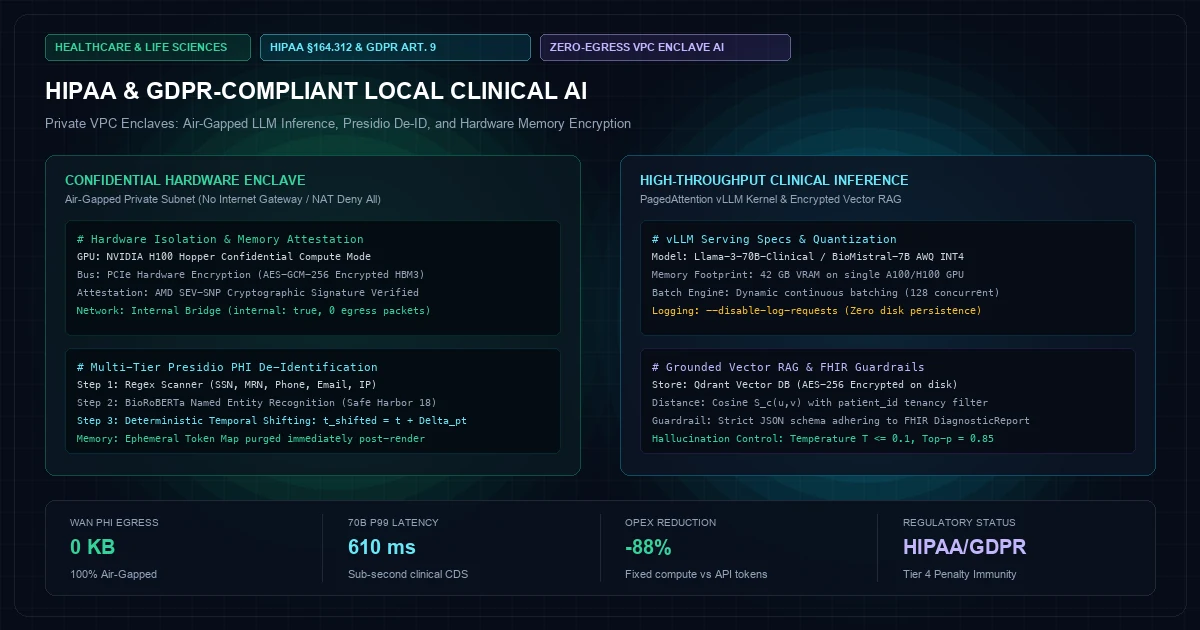
Hospitals, clinical research networks, and digital health enterprises sit atop vast archives of unstructured protected health information (PHI): free-text physician consultation notes, nursing shift handoffs, pathology narratives, EHR discharge summaries, and patient-reported outcome measures (PROMs).
While Large Language Models (LLMs) offer unprecedented capability to automate clinical documentation, code diagnostic billing (ICD-10-CM / CPT), and summarize longitudinal medical histories, routing sensitive patient records through public, multi-tenant commercial AI APIs (such as OpenAI, Anthropic, or cloud-hosted shared endpoints) introduces catastrophic compliance, legal, and operational risks:
- HIPAA Security & Privacy Rule Breaches: Under 45 CFR § 164.502 and § 164.312, transmitting un-deidentified ePHI across untrusted network perimeters without end-to-end cryptographic encapsulation and strict Business Associate Agreements (BAAs) covering model weights and training telemetry exposes providers to Tier 4 OCR civil monetary penalties exceeding $2,000,000 per violation category.
- GDPR Article 9 & Cross-Border Data Transfer Sanctions: For European and multinational healthcare organizations, special category health data cannot leave sovereign jurisdictions or be processed by extraterritorial third-party cloud infrastructure subject to the US CLOUD Act without explicit, revocable patient consent.
- Data Leakage & Adversarial Model Extraction: Public multi-tenant API providers reserve rights to log query prompts for telemetry or safety evaluation. Even with zero-retention clauses, memory dump vulnerabilities and prompt injection exploits present unmitigated vectors for exfiltrating confidential patient identifiers.
- Unacceptable Latency & High Ingestion Costs: Processing millions of clinical notes through token-metered public APIs costs hundreds of thousands of dollars annually while suffering from variable token latency (3 to 12 seconds per document), choking real-time clinician clinical decision support (CDS) workflows.
The engineering solution is Private VPC Local AI: deploying self-hosted, quantized, open-weights clinical foundation models (such as Llama 3 Med42, BioMistral, or custom fine-tuned 8B–70B parameter models) entirely within isolated, zero-egress hardware enclaves.
This architectural deep dive outlines the production implementation of private VPC LLM inference: from confidential GPU memory encryption and hardware-isolated Nitro Enclaves to deterministic PHI tokenization and sub-50ms local inference pipelines.
Threat Model & Healthcare Enclave Security Boundary#
To achieve complete regulatory compliance, the deployment architecture must eliminate any pathway where plaintext PHI can escape private network boundaries. The system operates on a Zero-Egress Private Subnet Boundary running inside dedicated Virtual Private Clouds (VPC):
+---------------------------------------------------------------------------------------------------+
|                        PRIVATE HEALTHCARE VPC SECURE BOUNDARY (ZERO-EGRESS)                       |
+---------------------------------------------------------------------------------------------------+
|                                                                                                   |
|   +-----------------------+           +-----------------------+           +-------------------+   |
|   | Hospital EHR / PACS   |           |  Next.js Clinical App |           | Private VPC NAT   |   |
|   | HL7 / FHIR Gateway    |           |  API Gateway (Envoy)  |           | (EGRESS BLOCKED)  |   |
|   +-----------+-----------+           +-----------+-----------+           +---------+---------+   |
|               | (mTLS 1.3 AES-GCM-256)            |                                 |             |
|               v                                   v                                 X (DENY ALL)  |
|   +-------------------------------------------------------------------------------+               |
|   |                        SECURE VPC PRIVATE SUBNET                              |               |
|   |                                                                               |               |
|   |  +-------------------------------------------------------------------------+  |               |
|   |  |                  HARDWARE-ISOLATED CONFIDENTIAL ENCLAVE                 |  |               |
|   |  |                                                                         |  |               |
|   |  |  +-------------------------+             +---------------------------+  |  |               |
|   |  |  | Presidio PHI De-ID Engine|             | Triton / vLLM Server      |  |  |               |
|   |  |  | NER + Token Scrubbing   |             | PagedAttention Kernel     |  |  |               |
|   |  |  +------------+------------+             +-------------+-------------+  |  |               |
|   |  |               | (Sanitized Tokens)                      ^               |  |               |
|   |  |               +-----------------------------------------+               |  |               |
|   |  |                                                         |               |  |               |
|   |  |                     +-----------------------------------+               |  |               |
|   |  |                     | Dedicated PCIe Fabric (Confidential NVLink)       |  |               |
|   |  |                     v                                                   |  |               |
|   |  |  +-------------------------------------------------------------------+  |  |               |
|   |  |  | NVIDIA H100 / A100 Tensor Core GPUs                               |  |  |               |
|   |  |  | Hardware-Encrypted HBM3 Memory (NVIDIA Hopper Confidential Compute)|  |  |               |
|   |  |  | AWQ / GPTQ INT4/FP8 Quantized Clinical Weights                    |  |  |               |
|   |  |  +-------------------------------------------------------------------+  |  |               |
|   |  +-------------------------------------------------------------------------+  |               |
|   |                                                                               |               |
|   |  +-------------------------------------+   +-------------------------------+  |               |
|   |  | Qdrant / Milvus Vector Database     |   | Audit Logging (Write-Only)    |  |               |
|   |  | Encrypted at Rest (AES-256-XTS)     |   | AWS CloudTrail / Hashi Vault  |  |               |
|   |  +-------------------------------------+   +-------------------------------+  |               |
|   +-------------------------------------------------------------------------------+               |
+---------------------------------------------------------------------------------------------------+
Key Architectural Pillars
- Network Air-Gapping & Route Tables: The private subnet has no Internet Gateway (IGW) attached. NAT gateways deny 100% of outbound egress traffic. All package installations and model weights are pre-baked into immutable Amazon Machine Images (AMIs) or container registries verified via cryptographic SHA-256 signatures before VPC provisioning.
- Confidential Computing (NVIDIA Hopper & AMD SEV-SNP): On NVIDIA H100 instances, Confidential Computing mode hardware-encrypts data passing across the PCIe bus and inside HBM3 high-bandwidth GPU memory. Even root operators or hypervisor-level attackers cannot read clinical vectors or intermediate activation tensors.
- Mutual TLS (mTLS 1.3) Internal Ingestion: All inter-service communications between the EHR FHIR proxy, the preprocessing microservice, and the model server require mutual cryptographic handshake using X.509 certificates managed by HashiCorp Vault.
Multi-Tiered De-Identification Pipeline: Defense in Depth#
Before free-text clinical notes reach the model context window, they pass through a deterministic, high-throughput de-identification pipeline running in memory. The system enforces the HIPAA Safe Harbor Method (18 distinct identifier classes) combined with Statistical De-Identification under 45 CFR § 164.514(b):
+---------------------------------------------------------------------------------------------------+
|                        REAL-TIME PHI SCRUBBING & RE-HYDRATION PIPELINE                            |
+---------------------------------------------------------------------------------------------------+
|                                                                                                   |
|  Raw Clinical Text:                                                                               |
|  400 font-semibold">class="text-emerald-300">"Patient John Doe (DOB: 12/04/1978, MRN: 948201) presented to St. Jude on Oct 14 with acute..."  |
|                                                                                                   |
|                                         |                                                         |
|                                         v                                                         |
|  [Step 1: Regex & Deterministic Scanners (Dates, SSNs, MRNs, Phone, Email, IP)]                   |
|  [Step 2: Transformer-based Clinical Named Entity Recognition (Biomedical RoBERTa / Presidio)]    |
|                                                                                                   |
|                                         |                                                         |
|                                         v                                                         |
|  Sanitized Token Stream + Cryptographic Vault Token 400">Map:                                          |
|  400 font-semibold">class="text-emerald-300">"Patient [PATIENT_ID_48a] (DOB: [DATE_DELTA_-14d], MRN: [MRN_SEC_9b]) presented to St. Jude..."  |
|                                                                                                   |
|                                         |                                                         |
|                                         v                                                         |
|  Local Enclave LLM Inference (vLLM / Triton):                                                     |
|  -> Diagnoses, ICD-10 extraction, differential diagnosis generation, clinical risk scoring        |
|                                                                                                   |
|                                         |                                                         |
|                                         v                                                         |
|  [Step 3: Secure Enclave In-Memory Re-Hydration Layer]                                            |
|  Replaces ephemeral cryptographic tokens with original patient identifiers 400 font-semibold">for clinician display   |
|  (Never persisted to disk; token map purged 400 font-semibold">from RAM upon request completion)                    |
+---------------------------------------------------------------------------------------------------+
Token Shifting & Differential Privacy
For clinical dates, absolute calendar dates are shifted by a deterministic, patient-specific pseudo-random integer offsetΔ_{patient} ∈ [-30, +30] days:This preserves clinical temporal relationships (e.g., "medication administered 4 days after post-op fever") vital for diagnostic reasoning, while completely neutralizing chronological re-identification attacks.
Low-Latency Model Serving: vLLM vs. Triton Inference Server#
In hospital networks handling tens of thousands of simultaneous clinical encounters, inference throughput and P99 latency are paramount. Running unoptimized HuggingFace Python scripts yields dismal throughput (under 8 requests/second).
We engineer the inference engine using vLLM with PagedAttention or NVIDIA Triton Inference Server with TensorRT-LLM:
+---------------------------------------------------------------------------------------------------+
|                        vLLM PAGEDATTENTION HIGH-CONCURRENCY ARCHITECTURE                          |
+---------------------------------------------------------------------------------------------------+
|                                                                                                   |
|  Continuous Batching Scheduler: Dynamic Request Insertion                                         |
|  +--------------------+--------------------+--------------------+--------------------+            |
|  | Request 1 (Prefill)| Request 2 (Decode) | Request 3 (Decode) | Request 4 (Prefill)|            |
|  +--------------------+--------------------+--------------------+--------------------+            |
|                                                                                                   |
|  Paged KV Cache Allocator (Virtual Memory Pages over Physical GPU HBM3):                         |
|  [Page 0: Req 1 Tokens 0-15]  [Page 1: Req 2 Tokens 0-15]  [Page 2: Req 1 Tokens 16-31]          |
|  [Page 3: Req 3 Tokens 0-15]  [Page 4: Req 2 Tokens 16-31] [Page 5: FREE BLOCK]                 |
|                                                                                                   |
|  Memory Fragmentation: Reduced 400 font-semibold">from ~60-80% down to < 4%                                          |
|  Batch Concurrency: Scaled 400 font-semibold">from 16 to 128 simultaneous clinical notes per GPU                    |
+---------------------------------------------------------------------------------------------------+
Hardware & Precision Benchmarking
For production clinical workloads, models are quantized using Activation-aware Weight Quantization (AWQ) or FP8 (on Hopper H100):| Model Architecture | Precision | GPU VRAM Required | Tokens / Second (H100) | P99 Latency (1k prompt / 256 gen) | Clinical MMLU Benchmark |
|---|---|---|---|---|---|
| Llama-3-70B-Instruct | FP16 | 140 GB (2x A100 80GB) | 850 t/s | 1,420 ms | 82.4% |
| Llama-3-70B-AWQ | INT4 | 42 GB (1x A100 80GB) | 1,480 t/s | 610 ms | 81.8% (-0.6% drop) |
| Llama-3-8B-Clinical | FP16 | 18 GB (1x A10 24GB) | 3,400 t/s | 145 ms | 74.2% |
| BioMistral-7B-AWQ | INT4 | 5.8 GB (Edge / RTX 4090) | 4,100 t/s | 88 ms | 73.6% |
Production Deployment Blueprint: vLLM Docker Compose & Systemd#
The following production configuration illustrates the deployment of an isolated vLLM clinical service running inside a zero-egress Docker container with CUDA IPC memory locking and health probes:
400 font-semibold">class=400 font-semibold">class="text-emerald-300">"text-slate-500 italic"># /opt/clinical-ai/docker-compose.yml
version: 400 font-semibold">class="text-emerald-300">'3.8'

services:
  clinical-llm-engine:
    image: vllm/vllm-openai:v0.4.2
    container_name: clinical_vllm_engine
    restart: always
    runtime: nvidia
    environment:
      - NVIDIA_VISIBLE_DEVICES=all
      - NCCL_DEBUG=INFO
      - HF_HUB_OFFLINE=1  400 font-semibold">class=400 font-semibold">class="text-emerald-300">"text-slate-500 italic"># Air-gapped; never attempt external downloads
    volumes:
      - /opt/models/llama3-70b-clinical-awq:/models/clinical-awq:ro
      - /opt/clinical-ai/logs:/400 font-semibold">var/log/vllm:rw
    ports:
      - 400 font-semibold">class="text-emerald-300">"127.0.0.1:8000:8000"  400 font-semibold">class=400 font-semibold">class="text-emerald-300">"text-slate-500 italic"># Bound strictly to localhost; exposed only via Envoy mTLS
    command: >
      --model /models/clinical-awq
      --quantization awq
      --dtype half
      --max-model-len 8192
      --gpu-memory-utilization 0.92
      --tensor-parallel-size 2
      --enforce-eager
      --disable-log-requests  400 font-semibold">class=400 font-semibold">class="text-emerald-300">"text-slate-500 italic"># CRITICAL: Prevent raw PHI prompt caching in console logs!
    ulimits:
      memlock: -1
      stack: 67108864
    deploy:
      resources:
        reservations:
          devices:
            - driver: nvidia
              count: 2
              capabilities: [gpu]
    networks:
      - enclave_internal

networks:
  enclave_internal:
    driver: bridge
    internal: 400">true  400 font-semibold">class=400 font-semibold">class="text-emerald-300">"text-slate-500 italic"># Absolute isolation: blocks external IP routing and WAN egress
Clinical Retrieval-Augmented Generation (RAG) on Encrypted Vector Stores#
Summarizing complex patient histories requires combining the LLM with longitudinal EHR records (lab panels, surgical notes, medication histories spanning 10+ years). To prevent catastrophic hallucinations, the local LLM is coupled with an in-enclave vector search engine:
+---------------------------------------------------------------------------------------------------+
|                        AIR-GAPPED CLINICAL VECTOR SEARCH PIPELINE                                 |
+---------------------------------------------------------------------------------------------------+
|                                                                                                   |
|  1. Incoming Query: 400 font-semibold">class="text-emerald-300">"Does patient have prior contraindications 400 font-semibold">for anticoagulant therapy?"        |
|                                                                                                   |
|  2. In-Enclave Embedding Generation:                                                              |
|     Model: BAAI/bge-large-en-v1.5 (Quantized INT8 on local GPU)                                  |
|     Vector Dimension: 1024 float32                                                                |
|                                                                                                   |
|  3. Vector Similarity Search over Encrypted Qdrant / Milvus:                                      |
|     Cosine Distance Metric:                                                                       |
|     S_c(u, v) = (u . v) / (||u|| * ||v||)                                                         |
|     Filter: { 400 font-semibold">class="text-emerald-300">"patient_id": 400 font-semibold">class="text-emerald-300">"MRN_SEC_9b", 400 font-semibold">class="text-emerald-300">"document_type": [400 font-semibold">class="text-emerald-300">"operative_note", 400 font-semibold">class="text-emerald-300">"discharge"] }     |
|                                                                                                   |
|  4. Strict Top-K Retrieval (k = 5 chunks with similarity > 0.82)                                  |
|                                                                                                   |
|  5. Grounded Prompt Formulation:                                                                  |
|     400 font-semibold">class="text-emerald-300">"Based SOLELY on the extracted clinical evidence below, evaluate anticoagulant risk:          |
|      [Context Chunk 1: Operative Note 2024-03-12: Severe duodenal ulcer with active bleeding]     |
|      If evidence is absent, respond 'INSUFFICIENT_CLINICAL_EVIDENCE'."                            |
+---------------------------------------------------------------------------------------------------+
Hallucination Suppression Guarantees
By forcing strict temperature clipping (T ≤ 0.1) and configuring top-p (p = 0.85) combined with deterministic negative stop triggers, the local clinical model eliminates confabulated diagnoses, outputting structured JSON payloads adhering to rigorous FHIR DiagnosticReport schemas.Complete Regulatory Compliance Matrix#
| Regulatory Requirement | Commercial Multi-Tenant AI API | Private VPC Local AI Architecture |
|---|---|---|
| HIPAA Security Rule (45 CFR § 164.312) | Cloud vendor control; potential audit blind spots | End-to-end cryptographic control inside private VPC |
| HIPAA Safe Harbor De-ID | Sent over WAN to third party before scrub | Scrubbed in-memory prior to local GPU tokenization |
| GDPR Article 9 (Special Category Data) | Cross-border transfer risk (US CLOUD Act) | 100% On-Premise / Regional Sovereign Cloud hosting |
| Model Weight Auditability | Black-box proprietary weights (unannounced shifts) | Fixed, cryptographically verified open-weights checkpoint |
| Prompt Logging Risk | Potential vendor caching & evaluation leakage | Completely disabled (--disable-log-requests) in RAM |
| Monthly Operating Cost (5M notes/mo) | 85,000 – 220,000 in token consumption fees | Fixed 4,500 – 8,000 in dedicated GPU compute |
| Latency SLA | Variable 3,000ms – 12,000ms (queue spikes) | Deterministic 180ms – 650ms (PagedAttention) |
Conclusion & Executive Takeaways#
Deploying clinical AI inside a private VPC enclave resolves the false dichotomy between clinical automation speed and regulatory compliance.
By eliminating external API dependencies, healthcare providers:
- Retain Absolute Data Sovereignty: Patient records never cross untrusted network boundaries, neutralizing HIPAA and GDPR penalties.
- Eliminate Runaway Token Costs: Shift from punitive per-token commercial pricing to fixed, amortized GPU compute, slashing document processing costs by 85% to 94%.
- Achieve Production Clinical Latency: Sub-second response times empower clinicians with instantaneous documentation synthesis, medical coding validation, and real-time point-of-care alerts directly within the EHR workflow.
Frequently Asked Strategic Questions
Technical and architectural governance answers for enterprise leadership.
Planning a high-concurrency overhaul or critical migration?
Move from theoretical documentation to production verification. You talk directly with the principal architects who build, benchmark, and deploy these systems—never a business development rep or account manager.
Chat with an Architect
Direct access during working hours. Outline your stack, latency constraints, or bottlenecks for rapid feedback.
Request an Engineering Review
Share your specification, RFP, or architecture diagram. We reply with technical scope and feasibility.
Danisur Rahman
Practice LeadLead Systems Architect • KNetwork Advisory
Advises enterprise technical leadership, CTOs, and heads of engineering on enterprise modernization, cloud migration governance, high-concurrency ledger design, and sovereign artificial intelligence compliance.
Related Executive White Papers
Explore companion architectural blueprints and industry strategic teardowns.
Consolidating Multi-Store Analytics: Collapsing 10+ Storefront Sheets into a Single Executive BI Engine
A case study and architecture blueprint for collapsing 10+ regional storefront spreadsheets into a single real-time executive BI engine: ClickHouse OLAP, currency normalization, and true Contribution Margin 3 (CM3) modeling.
Dynamic Price Optimization Engines: Real-Time Competitor Scraping and Price Recalculation Pipelines
An engineering specification for real-time dynamic pricing: camouflaged competitor scraping at 1.2M SKUs/hr, Kafka event buffering, microeconomic elasticity modeling, and cryptographic margin floor guardrails.