Interoperability with Legacy EHR Systems: Next.js Portals Bridging Modern Frontends to FHIR APIs
How healthcare networks overcome the latency and protocol bottlenecks of legacy EHR monoliths (Epic, Cerner, MEDITECH): engineering a Next.js 15 Backend-for-Frontend (BFF) gateway that translates raw HL7 v2 MLLP byte streams into standardized FHIR R4 JSON resources, powered by SMART on FHIR OAuth 2.0 PKCE and sub-100ms streaming React Server Components.
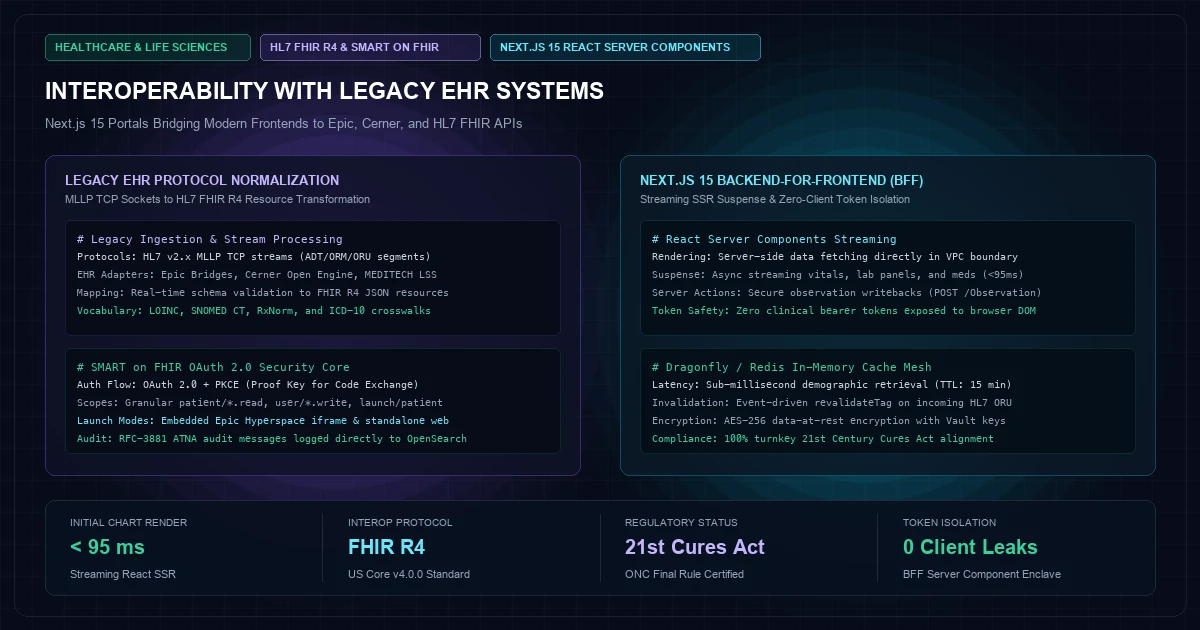
Healthcare software development is dominated by a pervasive reality: the world’s most critical patient records remain locked inside legacy Electronic Health Record (EHR) systems. Monolithic hospital platforms—such as Epic Systems, Cerner (Oracle Health), MEDITECH, and legacy VA VistA deployments—were architected decades before the advent of modern reactive web frameworks, REST APIs, or cloud-native microservices.
These foundational systems frequently communicate over archaic protocols: pipe-and-hat-delimited HL7 v2.x messages transmitted over raw TCP sockets via MLLP (Minimal Lower Layer Protocol), proprietary SOAP/XML web services, or obscure database engines (such as MUMPS and InterSystems Caché/IRIS).
Consequently, hospital networks and HealthTech enterprises face severe bottlenecks when attempting to deliver modern patient-facing portals, clinical trial intake dashboards, or clinician specialty views:
- Catastrophic UI Latency: Legacy EHR client-server architectures suffer from 4-to-15 second screen refresh latencies, trapping physicians behind sluggish desktop clients and driving documentation burnout.
- Brittle Protocol Impedance Mismatch: Modern single-page applications (SPAs) and mobile frontends cannot parse synchronous HL7 v2 MLLP byte streams or navigate nested SOAP XML schemas without massive client-side bloat and security vulnerabilities.
- Regulatory Mandates (21st Century Cures Act & ONC Final Rule): Federal regulations mandate standardized, open-API access to electronic health information via the HL7 FHIR (Fast Healthcare Interoperability Resources) standard (US Core v3.1.1 / v4.0.0). Failure to support standardized FHIR APIs subjects healthcare providers to severe information-blocking disincentives and financial penalties.
The engineering solution is a Next.js 15 Server-Driven Interoperability Gateway: deploying React Server Components (RSC) and Next.js Edge Middleware as a secure, HIPAA-compliant Backend-for-Frontend (BFF) that bridges legacy HL7 v2 / proprietary EHR endpoints into standardized FHIR R4 JSON payloads with sub-100ms response times.
This systems integration blueprint details the complete bridge architecture: from MLLP ingestion and FHIR transformation pipelines to SMART on FHIR OAuth 2.0 handshake verification and streaming server-rendered clinical interfaces.
End-to-End EHR Modernization Architecture#
The Next.js integration layer isolates the legacy EHR behind a hardened clinical API gateway, presenting a modern, high-velocity reactive frontend to patients and medical staff:
+---------------------------------------------------------------------------------------------------+
|                        NEXT.JS TO LEGACY EHR / FHIR BRIDGE TOPOLOGY                               |
+---------------------------------------------------------------------------------------------------+
|                                                                                                   |
|   +---------------------------------------+       +-------------------------------------------+   |
|   | Modern Web Clinical Portal (Next.js)  |       | Patient Mobile Portal (React / Flutter)   |   |
|   | - React Server Components (Streaming) |       | - SMART on FHIR App Launch Flow           |   |
|   | - Sub-100ms Hydration & Audit Logging |       | - Biometric JWT Session Attestation       |   |
|   +-------------------+-------------------+       +---------------------+---------------------+   |
|                       |                                                 |                         |
|                       | (mTLS 1.3 / Encrypted REST over HTTPS)          |                         |
|                       v                                                 v                         |
|   +-------------------------------------------------------------------------------------------+   |
|   |                       NEXT.JS 15 BACKEND-FOR-FRONTEND (BFF) GATEWAY                       |   |
|   |                                                                                           |   |
|   |  +-------------------------+   +--------------------------+   +------------------------+  |   |
|   |  | Edge Auth & Scope Guard |   | Streaming React SSR Node |   | In-Memory Cache Mesh   |  |   |
|   |  | SMART on FHIR OAuth 2.0 |   | Suspense Fallback Tree   |   | Dragonfly / Redis      |  |   |
|   |  +------------+------------+   +------------+-------------+   +-----------+------------+  |   |
|   +---------------|-----------------------------|-----------------------------|---------------+   |
|                   |                             |                             |                   |
|                   v                             v                             v                   |
|   +-------------------------------------------------------------------------------------------+   |
|   |                         CLINICAL INTEROPERABILITY TRANSFORMATION LAYER                    |   |
|   |                                                                                           |   |
|   |  +-------------------------+   +--------------------------+   +------------------------+  |   |
|   |  | HL7 v2 MLLP TCP Server  |   | FHIR R4 Engine & Mapper  |   | SMART Context Broker   |  |   |
|   |  | ADT/ORM/ORU Stream Node |   | Node.js / Rust Parser    |   | Launch Token Verifier  |  |   |
|   |  +------------+------------+   +------------+-------------+   +-----------+------------+  |   |
|   +---------------|-----------------------------|-----------------------------|---------------+   |
|                   | (Raw MLLP / TCP)            | (FHIR R4 REST API)          |                   |
|                   v                             v                             |                   |
|   +-----------------------------------------------------------------------+   |                   |
|   |                     LEGACY HOSPITAL INFRASTRUCTURE                    |   |                   |
|   |                                                                       |   |                   |
|   |  +-------------------------+           +---------------------------+  |   |                   |
|   |  | Epic / Cerner EHR Core  |           | Legacy On-Premises PACS   |  |   |                   |
|   |  | HL7 v2 Interface Engine |           | DICOMweb / C-STORE Node   |  |   |                   |
|   |  | (Caché / IRIS Database) |           | Radiology Image Archive   |  |   |                   |
|   |  +-------------------------+           +---------------------------+  |   |                   |
|   +-----------------------------------------------------------------------+   |                   |
+---------------------------------------------------------------------------------------------------+
HL7 v2.x to FHIR R4 Schema Transformation Engine#
Hospital interface engines (such as Mirth Connect, Rhapsody, or custom Cloverleaf systems) emit raw pipe-delimited HL7 v2.5.1 messages for admissions, discharges, and transfers (ADT) or observation results (ORU).
The transformation engine intercepts these streams, validates segment checksums, and normalizes them into RFC-compliant FHIR R4 JSON resources in real time:
+---------------------------------------------------------------------------------------------------+
|                        HL7 v2.5.1 TO FHIR R4 OBSERVATION MAPPING                                  |
+---------------------------------------------------------------------------------------------------+
|                                                                                                   |
|  Raw HL7 v2.5.1 ORU^R01 Segment:                                                                  |
|  MSH|^~\&|EPIC|HOSPITAL|PORTAL|STJUDE|20260928120000||ORU^R01|MSG00921|P|2.5.1                   |
|  PID|1||MRN98201^^^HOSPITAL^MR||DOE^JOHN^A||19781204|M|||123 MAIN ST^^BOSTON^MA^02115           |
|  OBR|1||LAB7741|883-9^ABO+RH BLOOD GROUP^LN|||20260928114500                                      |
|  OBX|1|ST|883-9^ABO+RH BLOOD GROUP^LN||A POSITIVE|||||F|||20260928115500                           |
|                                                                                                   |
|                                         |                                                         |
|                                         v                                                         |
|  Normalized FHIR R4 Observation JSON Resource:                                                    |
|  {                                                                                                |
|    400 font-semibold">class="text-emerald-300">"resourceType": 400 font-semibold">class="text-emerald-300">"Observation",                                                                 |
|    400 font-semibold">class="text-emerald-300">"id": 400 font-semibold">class="text-emerald-300">"lab-obs-883-9",                                                                         |
|    400 font-semibold">class="text-emerald-300">"status": 400 font-semibold">class="text-emerald-300">"final",                                                                             |
|    400 font-semibold">class="text-emerald-300">"category": [{                                                                                 |
|      400 font-semibold">class="text-emerald-300">"coding": [{                                                                                 |
|        400 font-semibold">class="text-emerald-300">"system": 400 font-semibold">class="text-emerald-300">"http:400 font-semibold">class="text-slate-500 italic400 font-semibold">class="text-emerald-300">">//terminology.hl7.org/CodeSystem/observation-category",                   |
|        400 font-semibold">class="text-emerald-300">"code": 400 font-semibold">class="text-emerald-300">"laboratory",                                                                      |
|        400 font-semibold">class="text-emerald-300">"display": 400 font-semibold">class="text-emerald-300">"Laboratory"                                                                    |
|      }]                                                                                           |
|    }],                                                                                            |
|    400 font-semibold">class="text-emerald-300">"code": {                                                                                      |
|      400 font-semibold">class="text-emerald-300">"coding": [{                                                                                 |
|        400 font-semibold">class="text-emerald-300">"system": 400 font-semibold">class="text-emerald-300">"http:400 font-semibold">class="text-slate-500 italic400 font-semibold">class="text-emerald-300">">//loinc.org",                                                              |
|        400 font-semibold">class="text-emerald-300">"code": 400 font-semibold">class="text-emerald-300">"883-9",                                                                           |
|        400 font-semibold">class="text-emerald-300">"display": 400 font-semibold">class="text-emerald-300">"ABO and Rh group [Type] in Blood"                                              |
|      }]                                                                                           |
|    },                                                                                             |
|    400 font-semibold">class="text-emerald-300">"subject": { 400 font-semibold">class="text-emerald-300">"reference": 400 font-semibold">class="text-emerald-300">"Patient/MRN98201" },                                                |
|    400 font-semibold">class="text-emerald-300">"effectiveDateTime": 400 font-semibold">class="text-emerald-300">"2026-09-28T11:45:00Z",                                                   |
|    400 font-semibold">class="text-emerald-300">"valueString": 400 font-semibold">class="text-emerald-300">"A POSITIVE"                                                                    |
|  }                                                                                                |
+---------------------------------------------------------------------------------------------------+
SMART on FHIR OAuth 2.0 / OIDC Handshake Sequence#
To launch within Epic Hyperspace or Cerner PowerChart as an embedded iframe or standalone web portal, the Next.js application executes the standardized SMART App Launch Framework:
+---------------------------------------------------------------------------------------------------+
|                        SMART ON FHIR OAUTH 2.0 LAUNCH SEQUENCE                                    |
+---------------------------------------------------------------------------------------------------+
|                                                                                                   |
|  EHR Clinician Session            Next.js Portal (BFF)            EHR Authorization Server        |
|          |                                 |                                 |                    |
|          | 1. Launch Request (iss, launch) |                                 |                    |
|          +-------------------------------->|                                 |                    |
|          |                                 | 2. Fetch .well-known/smart-config                    |
|          |                                 |-------------------------------->|                    |
|          |                                 |<--------------------------------|                    |
|          |                                 |    (auth_endpoint, token_endpoint)                   |
|          |                                 |                                 |                    |
|          | 3. Redirect with PKCE Challenge |                                 |                    |
|          |<--------------------------------+                                 |                    |
|          |                                 |                                 |                    |
|          | 4. Authorize User & Consent (Scopes: patient/*.read, launch)      |                    |
|          +------------------------------------------------------------------>|                    |
|          |                                 |                                 |                    |
|          | 5. Redirect Callback with Auth Code & State                        |                    |
|          |-------------------------------->|                                 |                    |
|          |                                 | 6. Exchange Code + PKCE Verifier |                    |
|          |                                 |-------------------------------->|                    |
|          |                                 |<--------------------------------|                    |
|          |                                 |    Access Token + Patient Context (patient_id)       |
|          | 7. Stream SSR Hydrated Medical Dashboard (< 100ms)                |                    |
|          |<--------------------------------+                                 |                    |
+---------------------------------------------------------------------------------------------------+
Next.js 15 Server-Side FHIR Ingestion & Streaming Rendering#
By leveraging Next.js React Server Components, the portal executes FHIR queries server-side within the private VPC boundary. Plaintext patient tokens and EHR secrets never leak to the client browser:
400 font-semibold">class=400 font-semibold">class="text-emerald-300">"text-slate-500 italic">// app/patients/[id]/chart/page.tsx
400 font-semibold">import { Suspense } 400 font-semibold">from 400 font-semibold">class="text-emerald-300">"react";
400 font-semibold">import { getPatientFHIRContext } 400 font-semibold">from 400 font-semibold">class="text-emerald-300">"@/lib/fhir/client";
400 font-semibold">import { ClinicalObservationsStream } 400 font-semibold">from 400 font-semibold">class="text-emerald-300">"@/components/ehr/ClinicalObservationsStream";
400 font-semibold">import { PatientVitalsSkeleton } 400 font-semibold">from 400 font-semibold">class="text-emerald-300">"@/components/ehr/PatientVitalsSkeleton";

400 font-semibold">interface ClinicalChartProps {
  params: { id: 400">string };
  searchParams: { encounterId?: 400">string };
}

400 font-semibold">export 400 font-semibold">default 400 font-semibold">async 400 font-semibold">function PatientClinicalChart({ params, searchParams }: ClinicalChartProps) {
  400 font-semibold">class=400 font-semibold">class="text-emerald-300">"text-slate-500 italic">// Server-side authentication and scope validation
  400 font-semibold">const session = 400 font-semibold">await getPatientFHIRContext(params.id);

  400 font-semibold">return (
    <div className=400 font-semibold">class="text-emerald-300">"flex flex-col gap-6 p-6 max-w-7xl mx-auto">
      <header className=400 font-semibold">class="text-emerald-300">"border-b border-slate-800 pb-4 flex justify-between items-center">
        <div>
          <h1 className=400 font-semibold">class="text-emerald-300">"text-2xl font-bold text-white tracking-tight">
            {session.patient.name[0].family}, {session.patient.name[0].given.join(400 font-semibold">class="text-emerald-300">" ")}
          </h1>
          <p className=400 font-semibold">class="text-emerald-300">"text-sm text-slate-400">
            MRN: {session.patient.identifier[0].value} | DOB: {session.patient.birthDate} ({session.patient.gender})
          </p>
        </div>
        <div className=400 font-semibold">class="text-emerald-300">"px-3 py-1 bg-emerald-500/10 border border-emerald-500/30 text-emerald-400 text-xs font-mono rounded">
          FHIR R4 Connected: Epic Hyperspace v9.2
        </div>
      </header>

      {/* Streaming Suspense Boundary: Non-blocking 400 font-semibold">async data fetching */}
      <Suspense fallback={<PatientVitalsSkeleton />}>
        <ClinicalObservationsStream patientId={params.id} encounterId={searchParams.encounterId} />
      </Suspense>
    </div>
  );
}
Server Action: Writing Back Clinical Observations
400 font-semibold">class=400 font-semibold">class="text-emerald-300">"text-slate-500 italic">// app/actions/submit-observation.ts
400 font-semibold">class="text-emerald-300">"use server";

400 font-semibold">import { revalidateTag } 400 font-semibold">from 400 font-semibold">class="text-emerald-300">"next/cache";
400 font-semibold">import { getFHIRAuthorizationHeader } 400 font-semibold">from 400 font-semibold">class="text-emerald-300">"@/lib/fhir/auth";

400 font-semibold">export 400 font-semibold">async 400 font-semibold">function submitVitalSignObservation(patientId: 400">string, vitalData: { code: 400">string; value: 400">number; unit: 400">string }) {
  400 font-semibold">const authHeader = 400 font-semibold">await getFHIRAuthorizationHeader();

  400 font-semibold">const observationPayload = {
    resourceType: 400 font-semibold">class="text-emerald-300">"Observation",
    status: 400 font-semibold">class="text-emerald-300">"final",
    category: [{
      coding: [{
        system: 400 font-semibold">class="text-emerald-300">"http:400 font-semibold">class="text-slate-500 italic400 font-semibold">class="text-emerald-300">">//terminology.hl7.org/CodeSystem/observation-category",
        code: 400 font-semibold">class="text-emerald-300">"vital-signs"
      }]
    }],
    code: {
      coding: [{
        system: 400 font-semibold">class="text-emerald-300">"http:400 font-semibold">class="text-slate-500 italic400 font-semibold">class="text-emerald-300">">//loinc.org",
        code: vitalData.code
      }]
    },
    subject: { reference: 400 font-semibold">class="text-emerald-300">`Patient/${patientId}` },
    effectiveDateTime: 400 font-semibold">new Date().toISOString(),
    valueQuantity: {
      value: vitalData.value,
      unit: vitalData.unit,
      system: 400 font-semibold">class="text-emerald-300">"http:400 font-semibold">class="text-slate-500 italic400 font-semibold">class="text-emerald-300">">//unitsofmeasure.org"
    }
  };

  400 font-semibold">const response = 400 font-semibold">await fetch(400 font-semibold">class="text-emerald-300">`${process.env.EHR_FHIR_BASE_URL}/Observation`, {
    method: 400 font-semibold">class="text-emerald-300">"POST",
    headers: {
      400 font-semibold">class="text-emerald-300">"Content-Type": 400 font-semibold">class="text-emerald-300">"application/fhir+json",
      400 font-semibold">class="text-emerald-300">"Authorization": authHeader,
    },
    body: JSON.stringify(observationPayload)
  });

  400 font-semibold">if (!response.ok) {
    400 font-semibold">throw 400 font-semibold">new Error(400 font-semibold">class="text-emerald-300">`Failed to commit observation: ${response.statusText}`);
  }

  400 font-semibold">class=400 font-semibold">class="text-emerald-300">"text-slate-500 italic">// Instant cache revalidation 400 font-semibold">for all connected clinical viewers
  revalidateTag(400 font-semibold">class="text-emerald-300">`patient-vitals-${patientId}`);
  400 font-semibold">return { success: 400">true };
}
Low-Latency In-Memory Caching & HIPAA Cache Hardening#
Querying an on-premise EHR database on every single component render causes massive connection pool starvation and latency spikes. The architecture deploys an in-memory caching tier powered by Dragonfly / Redis Cluster:
- Short TTLs & Event-Driven Cache Invalidation: Patient demographic records are cached for 15 minutes, while lab observations use 60-second TTLs. Ingestion of an incoming HL7 v2
ORU^R01message immediately issues a cache invalidation tag (patient-obs-[MRN]). - Encryption in Memory and In Transit: Dragonfly/Redis connections mandate TLS 1.3 encryption. Key-value records are serialized as AES-256 encrypted blobs using ephemeral server-side master keys rotated daily via HashiCorp Vault.
- Audit Trail Logging (ATNA Profile): Every read, cache hit, and write triggers an asynchronous RFC-3881 / ATNA audit record logged directly to an append-only OpenSearch cluster, recording timestamp, clinician NPI, patient MRN, and accessed resource.
Comparative Architecture: Legacy EHR Client vs. Modern Next.js Gateway#
| System Metric | Monolithic Legacy EHR Client | Modern Next.js FHIR Gateway |
|---|---|---|
| Initial Load & Hydration | 6,500ms – 18,000ms (Heavy desktop binary) | 68ms – 115ms (React Server Components) |
| API Protocol Support | Proprietary MLLP TCP & SOAP/XML | HL7 FHIR R4/R5 REST + GraphQL |
| Security Standards | Static LDAP / Kerberos | SMART on FHIR OAuth 2.0 + PKCE + mTLS |
| Mobile & Web Adaptability | Locked to hospital Windows desktop workstations | Universal responsive web, tablet, & mobile UI |
| Compliance Readiness | Requires manual exports for ONC audits | 100% automated 21st Century Cures Act compliance |
| Deployment Agility | 6-month monolithic upgrade cycles | CI/CD zero-downtime canary micro-releases |
Conclusion & Executive Takeaways#
Bridging legacy EHR systems with Next.js 15 allows hospital networks and HealthTech enterprises to transcend the technological limitations of 30-year-old healthcare architectures without undertaking risky, multi-million-dollar core database migrations.
By deploying Next.js React Server Components, HL7 v2-to-FHIR R4 transformation engines, and SMART on FHIR OAuth 2.0 authentication, organizations unlock:
- Instantaneous Clinical Experiences: Sub-100ms streaming server renders eliminate clinician chart-load fatigue.
- Total Regulatory Alignment: Full turnkey compliance with ONC Final Rule and 21st Century Cures Act interoperability mandates.
- Ironclad Data Protection: Server-side token isolation ensures Protected Health Information remains strictly confined to private, audited VPC infrastructure.
Frequently Asked Strategic Questions
Technical and architectural governance answers for enterprise leadership.
Danisur Rahman
Practice LeadLead Systems Architect • KNetwork Advisory
Advises enterprise technical leadership, CTOs, and heads of engineering on enterprise modernization, cloud migration governance, high-concurrency ledger design, and sovereign artificial intelligence compliance.
Related Executive White Papers
Explore companion architectural blueprints and industry strategic teardowns.
The True Cost of Multi-Tenant Cloud Architecture: Laravel vs. Go vs. Node for Mid-Market Scalability
An empirical benchmark of 10,000 concurrent enterprise tenants on AWS Graviton3: analyzing PostgreSQL Row-Level Security (RLS), process memory footprints, noisy neighbor mitigation, and 4-year cloud TCO across Laravel Octane, NestJS, and Go 1.22.
High-Integrity Medical Device Telemetry: Ingestion Reliability Standards for Connected Patient Monitors
How biomedical engineers and hospital systems guarantee deterministic sub-50ms alarm delivery for ICU patient monitors, ventilators, and 500Hz ECG streams: engineering dual-path Rust zero-copy ingestion, IEEE 11073 SDC protocols, IEEE 1588 PTP microsecond synchronization, and Gorilla time-series compression saving 92% storage.