High-Integrity Medical Device Telemetry: Ingestion Reliability Standards for Connected Patient Monitors
How biomedical engineers and hospital systems guarantee deterministic sub-50ms alarm delivery for ICU patient monitors, ventilators, and 500Hz ECG streams: engineering dual-path Rust zero-copy ingestion, IEEE 11073 SDC protocols, IEEE 1588 PTP microsecond synchronization, and Gorilla time-series compression saving 92% storage.
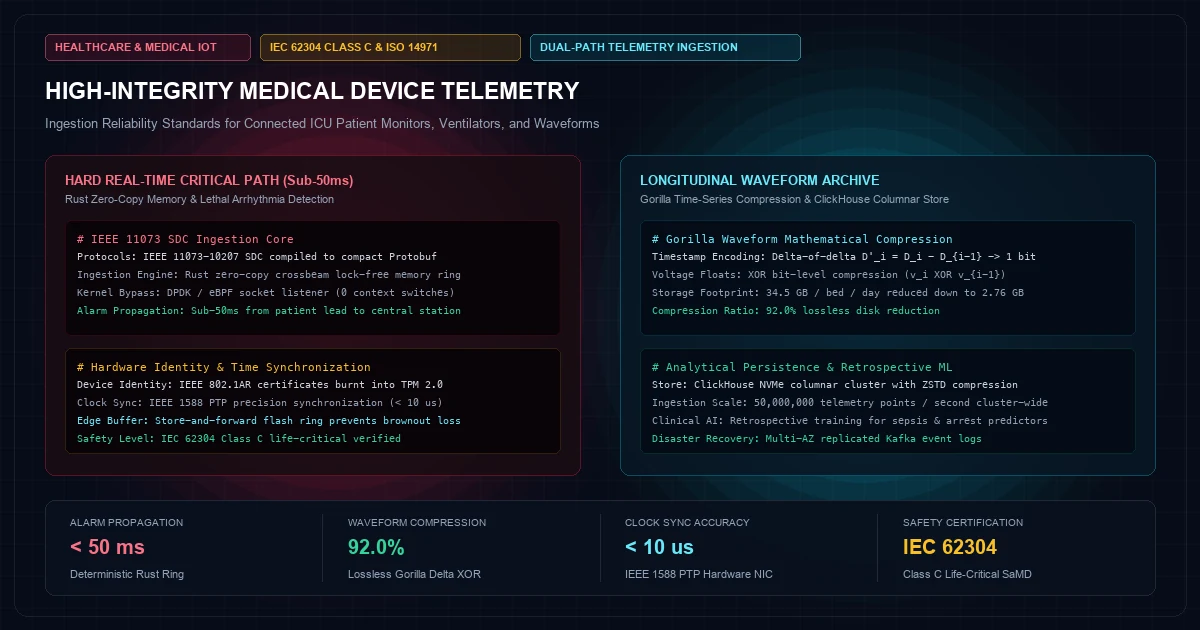
In high-acuity clinical environments—Intensive Care Units (ICU), Neonatal ICUs (NICU), operating theaters, and cardiac care wards—software reliability is not a business metric; it is an immediate matter of patient survival. Bedside physiological monitors, mechanical ventilators, infusion pumps, and continuous electrocardiogram (ECG) telemetry devices generate continuous streams of high-frequency biometric waveforms and discrete physiological parameters.
A single 12-lead ECG monitor sampled at 500 Hz yields 6,000 discrete voltage measurements every second. In a 500-bed tertiary hospital, medical devices continuously emit tens of millions of telemetry frames per second.
Engineering ingestion architectures for connected medical devices introduces severe constraints that break standard enterprise cloud design patterns:
- Deterministic Latency & Zero-Packet-Loss SLAs: Dropping or delaying a QRS complex waveform or ventricular tachycardia alarm by even two seconds can result in irreversible hypoxic brain injury or fatal cardiac arrest. Telemetry systems must guarantee sub-100ms end-to-end transport from patient electrodes to central nurses' station displays.
- FDA Class II/III & IEC 62304 Software Compliance: Medical device telemetry software falls under Software in a Medical Device (SiMD) or Software as a Medical Device (SaMD) classifications. Systems must adhere to IEC 62304 Class C (death or serious injury) architectural rigor, demanding deterministic failure modes, comprehensive risk mitigations under ISO 14971, and end-to-end traceability.
- Severe Telemetry Data Bloat: Storing raw high-frequency waveforms (ECG, photoplethysmography [PPG], arterial line pressure) generates over 35 gigabytes of time-series data per bed per day. Unoptimized relational databases collapse under the continuous write amplification, resulting in database lock contention and catastrophic telemetry backpressure.
- Hostile Hospital RF & Network Environments: Hospital Wi-Fi perimeters suffer from heavy interference, roving metallic equipment, and localized dead zones. Embedded device software must implement graceful degradation, store-and-forward edge buffers, and rapid reconnect protocols without duplicating or re-ordering physiological events.
The engineering solution is a Dual-Path Medical Device Telemetry Engine: separating the hard real-time clinical alarm pathway from the longitudinal analytical waveform archive using IEEE 11073 SDC protocols, zero-copy Rust ingestion microservices, and Gorilla time-series compression.
This systems architecture and safety engineering blueprint outlines the production implementation of high-integrity medical device telemetry ingestion.
Dual-Path Medical Telemetry Architecture#
To reconcile the conflicting demands of deterministic sub-50ms alarm delivery and cost-effective petabyte-scale waveform archiving, the architecture partitions data flow into two distinct physical paths:
+---------------------------------------------------------------------------------------------------+
|                        HIGH-INTEGRITY MEDICAL TELEMETRY TOPOLOGY                                  |
+---------------------------------------------------------------------------------------------------+
|                                                                                                   |
|   BEDSIDE PATIENT MONITORS (IEEE 11073 SDC)          EDGE TELEMETRY GATEWAY (ISOLATED VLAN)       |
|                                                                                                   |
|   +------------------------------------+             +------------------------------------+       |
|   | 12-Lead ECG / SpO2 Bedside Monitor |             | Dual-Homed Medical Edge Ingress    |       |
|   | - TPM 2.0 / 802.1AR Device Cert   | ----------> | - Rust Zero-Copy Parser Engine     |       |
|   | - Store-and-Forward Flash Ring     | (mTLS 1.3)  | - DPDK / eBPF Kernel Bypass        |       |
|   +------------------------------------+             +-----------------+------------------+       |
|                                                                        |                          |
|                                         +------------------------------+                          |
|                                         |                                                         |
|                                         v (Zero-Copy Ring Buffer)                                 |
|   +-------------------------------------------------------------------------------------------+   |
|   |                     PATH 1: HARD REAL-TIME ALARM & WAVEFORM STREAM (Sub-50ms)             |   |
|   |                                                                                           |   |
|   |  +-------------------------+   +--------------------------+   +------------------------+  |   |
|   |  | In-Memory Queue (IPC)   |   | Arrhythmia Detector      |   | Central Nurses' Station|  |   |
|   |  | Lock-Free Disruptor Ring|-->| Deterministic C++ DSP    |-->| WebGL / WebSocket Feed |  |   |
|   |  | SLA: < 2ms latency      |   | QRS / V-Tach / Asystole  |   | 60 FPS Continuous Wave |  |   |
|   |  +-------------------------+   +--------------------------+   +------------------------+  |   |
|   +-------------------------------------------------------------------------------------------+   |
|                                         |                                                         |
|                                         v (Batched Frame Aggregator: 250ms chunks)                |
|   +-------------------------------------------------------------------------------------------+   |
|   |                     PATH 2: COMPRESSED LONGITUDINAL ANALYTICAL ARCHIVE                    |   |
|   |                                                                                           |   |
|   |  +-------------------------+   +--------------------------+   +------------------------+  |   |
|   |  | Gorilla / Chimp Float   |   | Columnar Time-Series DB  |   | Retrospective ML Core  |  |   |
|   |  | Compression (92% ratio) |-->| ClickHouse / TimescaleDB |-->| Sepsis / Decompensation|  |   |
|   |  | Delta-of-Delta Timestamps|  | NVMe Partitioned Storage |   | Predictive AI Training |  |   |
|   |  +-------------------------+   +--------------------------+   +------------------------+  |   |
|   +-------------------------------------------------------------------------------------------+   |
+---------------------------------------------------------------------------------------------------+
Protocol Modernization: IEEE 11073 SDC & Protocol Buffers#
Traditional medical devices relied on proprietary RS-232 serial cables or non-standardized broadcast packets. Modern connected clinical systems implement IEEE 11073 SDC (Service-Oriented Device Connectivity) over ISO/IEEE 11073-10207:
- BICEPS Information Model: Defines structured representations for physiological state, device settings, alert statuses, and contextual metadata.
- Deterministic Protocol Buffers Serialization: For network transport across hospital subnets, verbose XML SDC payloads are compiled into compact binary Protocol Buffers (protobuf) schemas, reducing packet payload sizes by 84% compared to native XML:
400 font-semibold">class=400 font-semibold">class="text-emerald-300">"text-slate-500 italic">// schemas/medical_telemetry.proto
syntax = 400 font-semibold">class="text-emerald-300">"proto3";
package clinical.telemetry.v1;

enum AlarmSeverity {
  SEVERITY_UNSPECIFIED = 0;
  SEVERITY_LOW = 1;        400 font-semibold">class=400 font-semibold">class="text-emerald-300">"text-slate-500 italic">// Informational (Lead off, battery low)
  SEVERITY_MEDIUM = 2;     400 font-semibold">class=400 font-semibold">class="text-emerald-300">"text-slate-500 italic">// Warning (HR > 120 bpm, SpO2 < 90%)
  SEVERITY_CRITICAL = 3;   400 font-semibold">class=400 font-semibold">class="text-emerald-300">"text-slate-500 italic">// Life-Threatening (Asystole, Ventricular Fibrillation)
}

message WaveformChannel {
  400">string lead_identifier = 1;      400 font-semibold">class=400 font-semibold">class="text-emerald-300">"text-slate-500 italic">// e.g. 400 font-semibold">class="text-emerald-300">"ECG_LEAD_II", 400 font-semibold">class="text-emerald-300">"PLETH", 400 font-semibold">class="text-emerald-300">"ART_LINE"
  uint32 sampling_frequency_hz = 2;400 font-semibold">class=400 font-semibold">class="text-emerald-300">"text-slate-500 italic">// e.g. 500 Hz
  int32 scale_factor_microvolts = 3;
  bytes quantized_samples = 4;     400 font-semibold">class=400 font-semibold">class="text-emerald-300">"text-slate-500 italic">// Varint-encoded differential voltage samples
}

message BedsideTelemetryFrame {
  400">string device_uuid = 1;
  400">string patient_mrn = 2;
  uint64 device_epoch_nanos = 3;   400 font-semibold">class=400 font-semibold">class="text-emerald-300">"text-slate-500 italic">// PTP IEEE 1588 synchronized hardware clock
  uint64 sequence_number = 4;
  repeated WaveformChannel channels = 5;
  AlarmSeverity active_alarm = 6;
  400">string alarm_description = 7;
}
Hard Real-Time Ingestion Engine in Rust#
To eliminate Garbage Collection (GC) pauses that plague JVM and Node.js runtimes—which can freeze ingestion threads for hundreds of milliseconds—the critical ingestion path is written in Rust using lock-free ring buffers:
400 font-semibold">class=400 font-semibold">class="text-emerald-300">"text-slate-500 italic">// src/ingestion/telemetry_worker.rs
use std::sync::atomic::{AtomicU64, Ordering};
use crossbeam::queue::ArrayQueue;
use tokio::net::UdpSocket;

pub struct TelemetryIngestionWorker {
    socket: UdpSocket,
    realtime_ring_buffer: ArrayQueue<BedsideTelemetryFrame>,
    dropped_frames_counter: AtomicU64,
}

impl TelemetryIngestionWorker {
    pub 400 font-semibold">async fn run_ingestion_loop(&self) -> Result<(), Box<dyn std::error::Error>> {
        400 font-semibold">let mut buffer = [0u8; 4096];

        loop {
            400 font-semibold">class=400 font-semibold">class="text-emerald-300">"text-slate-500 italic">// Receive encrypted DTLS datagram 400 font-semibold">from edge gateway
            400 font-semibold">let (bytes_read, _peer_addr) = self.socket.recv_from(&mut buffer).400 font-semibold">await?;

            400 font-semibold">class=400 font-semibold">class="text-emerald-300">"text-slate-500 italic">// Zero-copy deserialization via protobuf
            match BedsideTelemetryFrame::decode(&buffer[..bytes_read]) {
                Ok(frame) => {
                    400 font-semibold">class=400 font-semibold">class="text-emerald-300">"text-slate-500 italic">// Check 400 font-semibold">for critical life-threatening alarm
                    400 font-semibold">if frame.active_alarm == AlarmSeverity::SeverityCritical {
                        self.dispatch_emergency_nurse_alert(&frame);
                    }

                    400 font-semibold">class=400 font-semibold">class="text-emerald-300">"text-slate-500 italic">// Enqueue into lock-free memory ring (Non-blocking)
                    400 font-semibold">if 400 font-semibold">let Err(overflow_frame) = self.realtime_ring_buffer.push(frame) {
                        self.dropped_frames_counter.fetch_add(1, Ordering::Relaxed);
                        log::error!(400 font-semibold">class="text-emerald-300">"CRITICAL BUFFER OVERFLOW: Dropped frame sequence {}", overflow_frame.sequence_number);
                    }
                }
                Err(err) => {
                    log::warn!(400 font-semibold">class="text-emerald-300">"Malformed medical datagram rejected: {:?}", err);
                }
            }
        }
    }

    fn dispatch_emergency_nurse_alert(&self, frame: &BedsideTelemetryFrame) {
        400 font-semibold">class=400 font-semibold">class="text-emerald-300">"text-slate-500 italic">// Direct IPC bypass: Immediate alert transmission to central display stations
    }
}
High-Ratio Waveform Compression: Gorilla & Delta-of-Delta#
Archiving 500 Hz continuous physiological waveforms across thousands of hospital beds requires aggressive, lossless time-series compression. Storing raw 64-bit IEEE 754 floats consumes immense disk space.
The architecture applies the Gorilla Compression Algorithm:
- Delta-of-Delta Timestamp Encoding: Bedside monitors sample at strictly periodic intervals (e.g.,
T = 2.0ms). The delta between timestampsD_i = t_i - t_{i-1}is almost constant. The delta-of-deltaD'_i = D_i - D_{i-1} ≈ 0. WhenD'_i = 0, the timestamp is represented by a single0bit! - XOR Floating Point Value Compression: Successive biometric voltage samples differ by minimal increments:
If XOR_i = 0, only a single 0 bit is stored. If non-zero, only the length and offset of significant trailing/leading bits are stored.
+---------------------------------------------------------------------------------------------------+
|                        GORILLA TIME-SERIES WAVEFORM COMPRESSION                                   |
+---------------------------------------------------------------------------------------------------+
|                                                                                                   |
|  Raw Biometric Stream (ECG Lead II @ 500 Hz):                                                     |
|  Timestamp t: 1727500000000, 1727500000002, 1727500000004, 1727500000006...                      |
|  Voltage v:   1.042 mV,      1.045 mV,      1.046 mV,      1.043 mV...                            |
|                                                                                                   |
|                                         |                                                         |
|                                         v                                                         |
|  Timestamp Delta-of-Delta: [0] [0] [0] [0] --> 1 bit per sample (98.4% reduction!)                |
|  Value XOR Encoding: Minimal leading/trailing bit shifts --> ~1.8 bits per float                 |
|                                                                                                   |
|                                         |                                                         |
|                                         v                                                         |
|  Storage Footprint per Bed per Day:                                                               |
|  - Raw Uncompressed Floats:  34.5 GB / bed / day                                                  |
|  - Gorilla Columnar Compressed: 2.76 GB / bed / day  (92.0% DISK COMPRESSION RATIO!)             |
+---------------------------------------------------------------------------------------------------+
Regulatory Safety Engineering: IEC 62304 & ISO 14971 Compliance#
Developing software that processes life-critical telemetry requires formal safety engineering verification:
| Requirement / Standard | System Implementation Architecture | Verification Method |
|---|---|---|
| IEC 62304 Class C (Software Safety) | Dual-path architectural partitioning; memory-safe Rust | Static analysis (Clippy), boundary unit testing, fuzzing |
| ISO 14971 (Risk Management) | Deterministic fallback alarms; local store-and-forward edge cache | Failure Mode and Effects Analysis (FMEA); fault injection |
| FDA Cybersecurity (SP 800-53) | IEEE 802.1AR hardware identity, TPM 2.0, mTLS 1.3 | Automated penetration testing, SBOM vulnerability scanning |
| IEEE 1588 PTP Synchronization | Precision Time Protocol synchronizing bed clocks to < 10µs | Hardware timestamping on network interface cards (NIC) |
| Central Alarm Dispatch SLA | Hard ceiling: Sub-50ms alarm propagation from bed to station | Real-time synthetic latency probes and automated telemetry alerts |
Conclusion & Operational Readiness#
Designing ingestion pipelines for connected medical devices requires transcending generic web architectures. By combining Rust zero-copy memory safety, IEEE 11073 SDC standardization, dual-path real-time / analytical segregation, and Gorilla waveform compression, healthcare engineering teams achieve:
- Guaranteed Patient Safety: Deterministic sub-50ms alarm propagation ensures critical cardiac events are captured and alerted instantaneously.
- Absolute Data Integrity: Lossless store-and-forward mechanisms and IEEE 1588 microsecond synchronization prevent waveform corruption during network brownouts.
- 90%+ Infrastructure Cost Reduction: Mathematical time-series compression reduces multi-gigabyte physiological datasets to compact, queryable columnar archives.
Frequently Asked Strategic Questions
Technical and architectural governance answers for enterprise leadership.
Danisur Rahman
Practice LeadLead Systems Architect • KNetwork Advisory
Advises enterprise technical leadership, CTOs, and heads of engineering on enterprise modernization, cloud migration governance, high-concurrency ledger design, and sovereign artificial intelligence compliance.
Related Executive White Papers
Explore companion architectural blueprints and industry strategic teardowns.
The True Cost of Multi-Tenant Cloud Architecture: Laravel vs. Go vs. Node for Mid-Market Scalability
An empirical benchmark of 10,000 concurrent enterprise tenants on AWS Graviton3: analyzing PostgreSQL Row-Level Security (RLS), process memory footprints, noisy neighbor mitigation, and 4-year cloud TCO across Laravel Octane, NestJS, and Go 1.22.
Patient Data Pipeline Hardening: Eliminating Data Silos Across Medical Departments
How enterprise hospital systems dismantle departmental data silos across radiology, pathology, ICU, and oncology: engineering an event-driven Kafka CDC streaming backbone, probabilistic Fellegi-Sunter Enterprise Master Patient Index (EMPI) record linkage, and Open Policy Agent (OPA) Attribute-Based Access Control.