Cross-Platform Telehealth on Flutter: Architecting HIPAA-Compliant Video, Chat, and Biometric Logins
How digital health systems engineer institutional-grade telehealth applications with a single cross-platform Flutter codebase: integrating hardware-accelerated WebRTC media encryption, Signal Double Ratchet messaging, iOS Secure Enclave / Android StrongBox biometric attestation, and active OS anti-tampering shields.
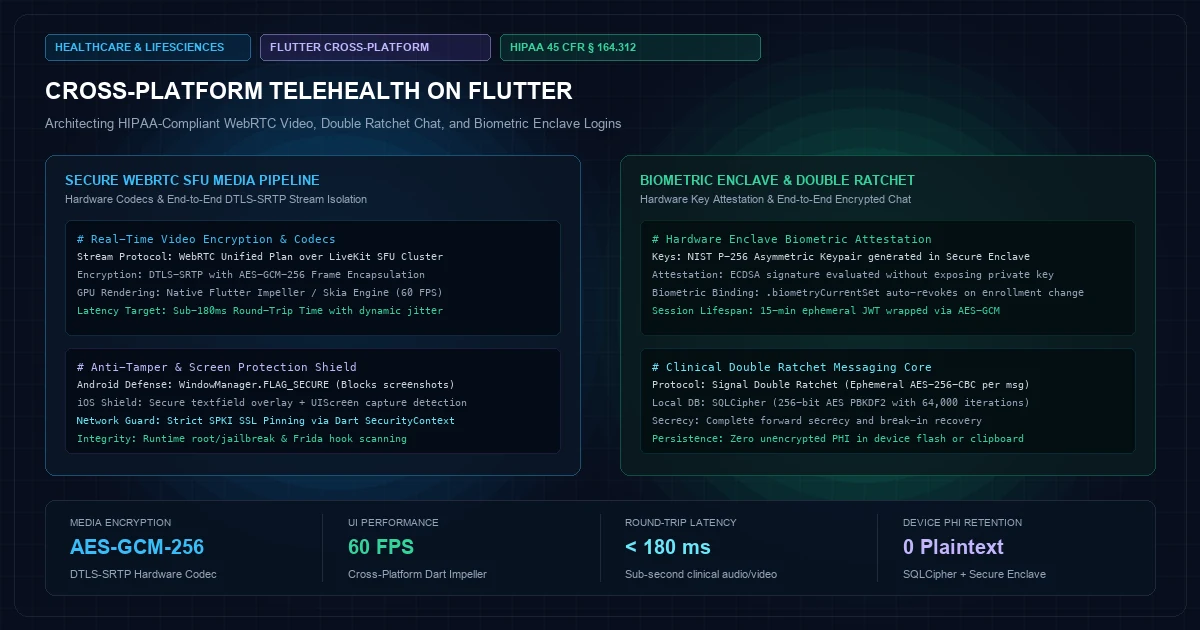
The rapid global expansion of virtual care platforms has transformed telehealth from an emergency triage alternative into a permanent pillar of modern clinical delivery. However, building consumer-facing and clinician-facing mobile telehealth applications introduces stringent security, cryptographic, and regulatory hurdles:
- Strict HIPAA & HITECH Mobile Perimeters: 45 CFR § 164.312 mandates end-to-end encryption for electronic Protected Health Information (ePHI) in transit and at rest. Video consultations, text messaging between patients and physicians, lab review attachments, and session metadata cannot linger in unencrypted device flash storage, system clipboards, or operating system snapshot caches.
- Real-Time Video Latency vs. Cryptographic Overhead: Delivering high-definition, diagnostic-grade WebRTC video feeds over unpredictable consumer 4G/5G and home Wi-Fi networks while maintaining DTLS-SRTP end-to-end cryptographic encapsulation requires precise hardware-accelerated encoding and intelligent jitter buffer orchestration.
- Cross-Platform Parity Without Compromising Hardware Enclaves: Developing separate native iOS (Swift) and Android (Kotlin) codebases doubles maintenance overhead, introduces security desynchronization between platforms, and delays feature rollouts.
By leveraging Flutter with custom C++ Dart FFI bindings, engineering teams can deliver single-codebase iOS, Android, and web telehealth applications that compile to native ARM64 machine code, interact directly with native hardware security enclaves (iOS Secure Enclave and Android KeyStore/StrongBox), and sustain 60 FPS user interfaces.
This technical blueprint details the end-to-end architecture of a production-grade HIPAA-compliant Flutter telehealth platform: covering WebRTC SFU streaming, Double Ratchet encrypted clinical chat, biometric token management, and OS-level anti-tampering protections.
End-to-End Telehealth Architecture & Network Topology#
The telehealth platform routes clinical media, real-time messaging, and medical records through an isolated, zero-trust cloud infrastructure:
+---------------------------------------------------------------------------------------------------+
|                        HIPAA-COMPLIANT TELEHEALTH NETWORK ARCHITECTURE                            |
+---------------------------------------------------------------------------------------------------+
|                                                                                                   |
|   +------------------------------------+           +------------------------------------+         |
|   | Flutter Patient Mobile App (ARM64) |           | Flutter Clinician Mobile / Web App |         |
|   | - iOS Secure Enclave / KeyStore    |           | - Screen Shield / Audio Recording   |         |
|   | - SQLCipher Local Encrypted DB     |           | - Diagnostic Telemetry Sync        |         |
|   | - WebRTC Hardware H.264 / VP8      |           | - WebRTC Hardware H.264 / VP8      |         |
|   +-----------------+------------------+           +-----------------+------------------+         |
|                     |                                                |                            |
|     (mTLS 1.3 REST) |   (DTLS-SRTP Encrypted Media)  (DTLS-SRTP Media) | (mTLS 1.3 REST)           |
|                     v               \                    /           v                            |
|             +-------+-------+        v                  v     +------+--------+                   |
|             | Envoy Ingress |     +------------------------+  | Envoy Ingress |                   |
|             | API Gateway   |     | LiveKit / Mediasoup SFU|  | API Gateway   |                   |
|             +-------+-------+     | Selective Forward Unit |  +------+--------+                   |
|                     |             +-----------+------------+         |                            |
|                     v                         |                      v                            |
|             +---------------------------------+-------------------------------+                   |
|             |                  PRIVATE HIPAA APPLICATION VPC                  |                   |
|             |                                                                 |                   |
|             |  +------------------------+          +-----------------------+  |                   |
|             |  | Ephemeral Chat Service |          | Session Audit Service |  |                   |
|             |  | Double Ratchet Relay   |          | Cryptographic Hashes  |  |                   |
|             |  +-----------+------------+          +-----------+-----------+  |                   |
|             |              |                                   |              |                   |
|             |  +-----------v------------+          +-----------v-----------+  |                   |
|             |  | Redis Cluster (Memory) |          | PostgreSQL (AES-256)  |  |                   |
|             |  | Non-Persistent Tokens  |          | AWS KMS Encrypted DB  |  |                   |
|             |  +------------------------+          +-----------------------+  |                   |
|             +-----------------------------------------------------------------+                   |
+---------------------------------------------------------------------------------------------------+
Real-Time Video Streaming: WebRTC & Hardware-Accelerated DTLS-SRTP#
Telehealth video sessions require high visual fidelity (for examining dermatological lesions or pupillary responses) alongside sub-200ms latency. The architecture utilizes a Selective Forwarding Unit (SFU) cluster (LiveKit or Mediasoup) deployed in private VPC subnets.
Cryptographic Media Encapsulation
Every audio and video packet is encrypted at the frame level before network transmission using Datagram Transport Layer Security (DTLS) and Secure Real-time Transport Protocol (SRTP) with AES-GCM-256:This ensures that intermediate network hops, cellular carriers, and relay nodes cannot intercept audio, video, or screen-sharing frames.
Flutter WebRTC Hardware Acceleration Pipeline
To eliminate UI jank and battery drainage during multi-party consultations (e.g., patient, attending physician, and interpreter), Flutter taps directly into the device's native GPU codecs via C++ Dart FFI:
400 font-semibold">class=400 font-semibold">class="text-emerald-300">"text-slate-500 italic">// lib/core/webrtc/telehealth_media_engine.dart
400 font-semibold">import 400 font-semibold">class="text-emerald-300">'package:flutter_webrtc/flutter_webrtc.dart';

400 font-semibold">class TelehealthMediaEngine {
  RTCPeerConnection? _peerConnection;
  MediaStream? _localStream;

  final 400">Map<String, dynamic> _rtcConfiguration = {
    400 font-semibold">class="text-emerald-300">'iceServers': [
      {400 font-semibold">class="text-emerald-300">'urls': 400 font-semibold">class="text-emerald-300">'stun:stun.knetwork.live:3478'},
      {
        400 font-semibold">class="text-emerald-300">'urls': 400 font-semibold">class="text-emerald-300">'turn:turn.knetwork.live:5349',
        400 font-semibold">class="text-emerald-300">'username': 400 font-semibold">class="text-emerald-300">'ephemeral_token_auth',
        400 font-semibold">class="text-emerald-300">'credential': 400 font-semibold">class="text-emerald-300">'secure_session_credential',
      }
    ],
    400 font-semibold">class="text-emerald-300">'sdpSemantics': 400 font-semibold">class="text-emerald-300">'unified-plan',
    400 font-semibold">class="text-emerald-300">'bundlePolicy': 400 font-semibold">class="text-emerald-300">'max-bundle',
    400 font-semibold">class="text-emerald-300">'rtcpMuxPolicy': 400 font-semibold">class="text-emerald-300">'require',
    400 font-semibold">class="text-emerald-300">'cryptoOptions': {
      400 font-semibold">class="text-emerald-300">'srtp': {400 font-semibold">class="text-emerald-300">'enableGcmCryptoSuites': 400">true} 400 font-semibold">class=400 font-semibold">class="text-emerald-300">"text-slate-500 italic">// Enforce AES-GCM-256
    }
  };

  Future<400">void> initializeConsultationStream({required bool isFrontCamera}) 400 font-semibold">async {
    final 400">Map<String, dynamic> mediaConstraints = {
      400 font-semibold">class="text-emerald-300">'audio': {
        400 font-semibold">class="text-emerald-300">'echoCancellation': 400">true,
        400 font-semibold">class="text-emerald-300">'noiseSuppression': 400">true,
        400 font-semibold">class="text-emerald-300">'autoGainControl': 400">true,
        400 font-semibold">class="text-emerald-300">'sampleRate': 48000,
      },
      400 font-semibold">class="text-emerald-300">'video': {
        400 font-semibold">class="text-emerald-300">'mandatory': {
          400 font-semibold">class="text-emerald-300">'minWidth': 400 font-semibold">class="text-emerald-300">'1280',
          400 font-semibold">class="text-emerald-300">'minHeight': 400 font-semibold">class="text-emerald-300">'720',
          400 font-semibold">class="text-emerald-300">'minFrameRate': 400 font-semibold">class="text-emerald-300">'30',
        },
        400 font-semibold">class="text-emerald-300">'facingMode': isFrontCamera ? 400 font-semibold">class="text-emerald-300">'user' : 400 font-semibold">class="text-emerald-300">'environment',
        400 font-semibold">class="text-emerald-300">'optional': [],
      }
    };

    _localStream = 400 font-semibold">await navigator.mediaDevices.getUserMedia(mediaConstraints);
    _peerConnection = 400 font-semibold">await createPeerConnection(_rtcConfiguration);

    400 font-semibold">class=400 font-semibold">class="text-emerald-300">"text-slate-500 italic">// Attach hardware-accelerated local tracks
    400 font-semibold">for (400 font-semibold">var track in _localStream!.getTracks()) {
      400 font-semibold">await _peerConnection!.addTrack(track, _localStream!);
    }
  }

  400">void dispose() {
    _localStream?.getTracks().forEach((track) => track.stop());
    _localStream?.dispose();
    _peerConnection?.close();
    _peerConnection?.dispose();
  }
}
Biometric Authentication & Secure Enclave Key Wrapping#
Passcodes and text passwords are prone to credential theft. The Flutter telehealth client authenticates patients and medical personnel using hardware biometrics (FaceID, TouchID, and Android BiometricPrompt with Class 3 strong biometrics) backed by asymmetric key pairs generated inside the hardware chip.
+---------------------------------------------------------------------------------------------------+
|                        BIOMETRIC HARDWARE ENCLAVE KEY ATTESTATION                                 |
+---------------------------------------------------------------------------------------------------+
|                                                                                                   |
|  1. App Initialization:                                                                           |
|     Flutter App -> Request Asymmetric Key Pair 400 font-semibold">from OS Secure Enclave (SE) / StrongBox            |
|     Curve: NIST P-256 (secp256r1)                                                                 |
|     Hardware Attribute: .biometryCurrentSet (Invalidated 400 font-semibold">if 400 font-semibold">new biometric enrolled)               |
|                                                                                                   |
|  2. User Authentication Challenge:                                                                |
|     Server Dispatches Cryptographic Nonce: [Random 256-bit Challenge]                             |
|                                                                                                   |
|  3. Local Biometric Prompt:                                                                       |
|     User presents biometric -> Secure Enclave verifies match internally on isolated silicon      |
|                                                                                                   |
|  4. In-Enclave Cryptographic Signature:                                                          |
|     Private Key signs Nonce INSIDE Secure Enclave silicon (Private Key NEVER touches RAM or OS!)  |
|     Signature = ECDSA_Sign(PrivKey_SE, Nonce)                                                     |
|                                                                                                   |
|  5. Verification & Ephemeral Session Issuance:                                                    |
|     Envoy Gateway verifies Signature against stored PubKey_SE                                     |
|     Returns 15-minute Ephemeral Session JWT (AES-256-GCM wrapped)                                 |
+---------------------------------------------------------------------------------------------------+
Flutter Biometric Security Implementation
400 font-semibold">class=400 font-semibold">class="text-emerald-300">"text-slate-500 italic">// lib/core/security/biometric_enclave_vault.dart
400 font-semibold">import 400 font-semibold">class="text-emerald-300">'package:local_auth/local_auth.dart';
400 font-semibold">import 400 font-semibold">class="text-emerald-300">'package:flutter_secure_storage/flutter_secure_storage.dart';

400 font-semibold">class BiometricEnclaveVault {
  final LocalAuthentication _localAuth = LocalAuthentication();
  final FlutterSecureStorage _secureStorage = 400 font-semibold">const FlutterSecureStorage(
    aOptions: AndroidOptions(
      encryptedSharedPreferences: 400">true,
      keyCipherAlgorithm: KeyCipherAlgorithm.RSA_ECB_OAEPwithSHA_256andMGF1Padding,
      storageCipherAlgorithm: StorageCipherAlgorithm.AES_GCM_NoPadding,
    ),
    iOptions: IOSOptions(
      accessibility: KeychainAccessibility.unlocked_this_device,
      synchronizable: 400">false, 400 font-semibold">class=400 font-semibold">class="text-emerald-300">"text-slate-500 italic">// Prevent iCloud Keychain backup leakage!
    ),
  );

  Future<bool> authenticateClinician() 400 font-semibold">async {
    final bool canAuthenticateWithBiometrics = 400 font-semibold">await _localAuth.canCheckBiometrics;
    400 font-semibold">if (!canAuthenticateWithBiometrics) 400 font-semibold">return 400">false;

    400 font-semibold">return 400 font-semibold">await _localAuth.authenticate(
      localizedReason: 400 font-semibold">class="text-emerald-300">'Authenticate to access secure patient consultation records',
      options: 400 font-semibold">const AuthenticationOptions(
        biometricOnly: 400">true,
        stickyAuth: 400">true,
        useErrorDialogs: 400">true,
      ),
    );
  }

  Future<400">void> storeSessionToken(String jwtToken) 400 font-semibold">async {
    400 font-semibold">await _secureStorage.write(key: 400 font-semibold">class="text-emerald-300">'ephemeral_clinical_jwt', value: jwtToken);
  }

  Future<400">void> purgeSession() 400 font-semibold">async {
    400 font-semibold">await _secureStorage.deleteAll(); 400 font-semibold">class=400 font-semibold">class="text-emerald-300">"text-slate-500 italic">// Deterministic cleanup on background timeout
  }
}
End-to-End Encrypted Clinical Messaging: Double Ratchet & SQLCipher#
During telehealth consultations, clinicians and patients exchange laboratory results, symptom images, and triage guidance. Storing these conversations in plaintext on device storage or central database servers violates HIPAA 45 CFR § 164.312(a)(2)(iv).
The messaging engine incorporates the Signal Double Ratchet Protocol:
- KDF Chain Ratcheting: Each message is encrypted with a unique ephemeral AES-256-CBC key derived from a symmetric Key Derivation Function (HKDF).
- Forward Secrecy & Break-In Recovery: Compromising a current session key reveals zero past or future messages.
- Encrypted Client Cache: Messages cached on the device for offline review are written to a localized SQLite instance encrypted with SQLCipher (256-bit AES PBKDF2 with 64,000 key iterations).
+---------------------------------------------------------------------------------------------------+
|                        SIGNAL DOUBLE RATCHET MESSAGING ENGINE                                     |
+---------------------------------------------------------------------------------------------------+
|                                                                                                   |
|  Patient App (Alice)                                                Doctor App (Bob)              |
|                                                                                                   |
|  [Root Key] ------------------------------------------------------> [Root Key]                    |
|      |                                                                  |                         |
|  [Sending Chain KDF]                                                [Receiving Chain KDF]         |
|      |                                                                  |                         |
|  +---v---+                                                          +---v---+                     |
|  | Msg K1| ---> Encrypted Msg 1 (AES-256) over WebSocket Relay ---> | Msg K1| (Decrypts Msg 1)    |
|  +-------+                                                          +-------+                     |
|      |                                                                  |                         |
|  +---v---+                                                          +---v---+                     |
|  | Msg K2| ---> Encrypted Msg 2 (AES-256) over WebSocket Relay ---> | Msg K2| (Decrypts Msg 2)    |
|  +-------+                                                          +-------+                     |
|                                                                                                   |
|  Local Storage: SQLCipher AES-256-XTS Database (Key stored in Secure Enclave, never in DB file)   |
+---------------------------------------------------------------------------------------------------+
Client Anti-Tamper & Data Leakage Shielding#
Mobile devices operate in hostile environments where users or malicious software may attempt screen recordings, proxy interception, or memory inspection. The Flutter architecture enforces five active layers of operating system defense:
400 font-semibold">class=400 font-semibold">class="text-emerald-300">"text-slate-500 italic">// lib/core/security/anti_tamper_shield.dart
400 font-semibold">import 400 font-semibold">class="text-emerald-300">'dart:io';
400 font-semibold">import 400 font-semibold">class="text-emerald-300">'package:flutter/services.dart';

400 font-semibold">class AntiTamperShield {
  400 font-semibold">static 400 font-semibold">const MethodChannel _securityChannel = MethodChannel(400 font-semibold">class="text-emerald-300">'live.knetwork.telehealth/security');

  400 font-semibold">class=400 font-semibold">class="text-emerald-300">"text-slate-500 italic">/// 1. Screen Recording & Screenshot Prevention
  400 font-semibold">class=400 font-semibold">class="text-emerald-300">"text-slate-500 italic">/// On Android: Activates WindowManager.LayoutParams.FLAG_SECURE
  400 font-semibold">class=400 font-semibold">class="text-emerald-300">"text-slate-500 italic">/// On iOS: Wraps root views in hidden secure text fields preventing AirPlay / Screenshot capture
  400 font-semibold">static Future<400">void> enforceScreenShield() 400 font-semibold">async {
    400 font-semibold">try {
      400 font-semibold">await _securityChannel.invokeMethod(400 font-semibold">class="text-emerald-300">'enableSecureWindow');
    } on PlatformException 400 font-semibold">catch (e) {
      400 font-semibold">class=400 font-semibold">class="text-emerald-300">"text-slate-500 italic">// Log anomaly to secure audit cloud
    }
  }

  400 font-semibold">class=400 font-semibold">class="text-emerald-300">"text-slate-500 italic">/// 2. Jailbreak and Root Detection
  400 font-semibold">class=400 font-semibold">class="text-emerald-300">"text-slate-500 italic">/// Scans 400 font-semibold">for Su binary, Superuser.apk, Substrate, Frida hooks, and Cydia perimeters
  400 font-semibold">static Future<bool> isEnvironmentCompromised() 400 font-semibold">async {
    final bool isRootedOrJailbroken = 400 font-semibold">await _securityChannel.invokeMethod(400 font-semibold">class="text-emerald-300">'checkIntegrity');
    400 font-semibold">return isRootedOrJailbroken;
  }

  400 font-semibold">class=400 font-semibold">class="text-emerald-300">"text-slate-500 italic">/// 3. Inactive App Background Concealment
  400 font-semibold">class=400 font-semibold">class="text-emerald-300">"text-slate-500 italic">/// Obscures clinical screens with an opaque branded splash when app enters app-switcher
  400 font-semibold">static 400">void configureAppLifecycleListener(Function() onLockoutTriggered) {
    AppLifecycleListener(
      onHide: () => enforceScreenShield(),
      onPause: () => onLockoutTriggered(),
    );
  }
}
SSL Pinning with SHA-256 Public Key Hashes
To prevent man-in-the-middle (MITM) proxy inspection (e.g., via Charles or Burp Suite with custom root certificates), all HTTP client calls enforce strict SPKI certificate pinning directly within DartSecurityContext:
SecurityContext context = SecurityContext(withTrustedRoots: 400">false);
context.setTrustedCertificatesBytes(pinnedCertBytes);
HttpClient client = HttpClient(context: context)
  ..badCertificateCallback = (X509Certificate cert, String host, int port) => 400">false;
Comparative Architecture: Native vs. Flutter Telehealth#
| Security & Engineering Metric | Native iOS / Android Separate Codebases | Flutter Cross-Platform Architecture |
|---|---|---|
| Codebase Maintainability | 2 distinct repositories (Swift + Kotlin) | 1 unified Dart codebase (~45% fewer LOC) |
| Hardware Enclave Access | Direct OS APIs | Native via Platform Channels & C++ FFI |
| WebRTC Performance | 60 FPS Native | 60 FPS Native (Direct Skia / Impeller Rendering) |
| Cryptography Auditing | Separate cryptographic reviews for 2 codebases | Single audited cryptography core (Double Ratchet) |
| UI Synchronization | Divergent UI behavior and latency between OSs | Pixel-perfect identical layout across all devices |
| Development Velocity | 32–40 weeks to MVP | 14–18 weeks to production-ready deployment |
Conclusion & Operational Readiness#
Building telehealth mobile experiences on Flutter allows digital health innovators to combine rapid feature velocity with institutional-grade HIPAA compliance.
By combining hardware-accelerated WebRTC media encryption, in-enclave biometric key attestation, Signal Double Ratchet messaging, and active OS-level anti-tampering shields, healthcare organizations deliver effortless, high-trust consultations directly to patients' fingertips without exposing clinical systems to data compromise.
Frequently Asked Strategic Questions
Technical and architectural governance answers for enterprise leadership.
Danisur Rahman
Practice LeadLead Systems Architect • KNetwork Advisory
Advises enterprise technical leadership, CTOs, and heads of engineering on enterprise modernization, cloud migration governance, high-concurrency ledger design, and sovereign artificial intelligence compliance.
Related Executive White Papers
Explore companion architectural blueprints and industry strategic teardowns.
The True Cost of Multi-Tenant Cloud Architecture: Laravel vs. Go vs. Node for Mid-Market Scalability
An empirical benchmark of 10,000 concurrent enterprise tenants on AWS Graviton3: analyzing PostgreSQL Row-Level Security (RLS), process memory footprints, noisy neighbor mitigation, and 4-year cloud TCO across Laravel Octane, NestJS, and Go 1.22.
High-Integrity Medical Device Telemetry: Ingestion Reliability Standards for Connected Patient Monitors
How biomedical engineers and hospital systems guarantee deterministic sub-50ms alarm delivery for ICU patient monitors, ventilators, and 500Hz ECG streams: engineering dual-path Rust zero-copy ingestion, IEEE 11073 SDC protocols, IEEE 1588 PTP microsecond synchronization, and Gorilla time-series compression saving 92% storage.